Showing posts with label Role Models. Show all posts

Tuesday, April 11, 2017

Beaver Dusters Mentoring & Speaker

At the instigation of Linda Downing, founder and director of Beaver Dusters Mentoring Program, Alton Carter, former foster youth, author, and speaker, spoke to students and faculty of Beaver Public Schools. 

Background
With encouragement from the Oklahoma Foundation for Excellence and the David and Molly Boren Mentoring Program, Beaver Dusters were able to bring Alton Carter to speak to the students in grades one through 12. All the mentors, teachers and students found his story to be tough but inspirational. When someone thinks his or her life is hard, he or she needs only to stop and remember how Alton grew up. He was the first one in his family to graduate from high school and later from Oklahoma State University. He never knew his father, and his mother and several members of his family were drug addicts. While very young, he knew he did not want to be like most of his family. At age nine, the Department of Human Services took him and his siblings away from their mother, and Alton later was sent to a boys' ranch near Perry. At the boys' ranch, Alton was guaranteed food if he didn't get cross-ways with the head master. Tough on all of the boys, the head master treated them like slaves more than young boys who could really use someone they respected.

Zavier and Alton Carter

Alton's Day 
He began by going to Mrs. Megan Stewart's fourth grade class. As a class project, Mrs. Stewart each day had been reading The Boy Who Carried Bricks, Alton's story. Mrs. Stewart told the class to close their eyes because she had a surprise for them. Alton went to the front of the room, and the class was told to open their eyes. In unison, they yelled out, "ALTON CARTER!" They were thrilled they actually met a real, live author. He spent 30 minutes with the class, and then grades four through 12 went to the auditorium where he spoke for over an hour. One high school teacher later commented that usually high school kids get antsy after a short while and even try to sneak a peek at their cell phones. That day all kids, grades four through 12, were spellbound for over an hour. Then he visited the lunch room but never ate. Instead Alton spent time talking to kids one-on-one. 

Alton's speaking to Beaver first through third graders.
Following the assembly, Alton visited with grades five and six, and again the kids had a lot of questions for him. From there Alton went to the primary building. Grades one through three huddled in the center of the room, and Alton visited with this age group for 30-45 minutes.

Alton in 2017
Alton resides in Stillwater where he lived as a young boy before being sent to the boys' ranch. He is the youth minister for Stillwater's United Methodist Church. Married, he has two sons. One son is in college at Oklahoma State, and the other is in high school. 

His Books
To learn more about Alton's book, see the link below. The gripping story makes readers continue--often in one sitting. Aging Out, his second book, is a continuation of his life after leaving the boys' ranch and then being in a foster home. In Oklahoma, foster youths are automatically put out of foster homes at age 18, and many end up homeless because no one cares. Emotional and social support ends abruptly. 

Alton Carter's website http://www.altoncarter.net/ 

Amazon https://www.amazon.com/Carried-Bricks-True-Story-Survival/dp/1937054349/ref=sr_1_1?ie=UTF8&qid=1424126365&sr=8-1&keywords=The+Boy+Who+Carried+Bricks 

Note:

The loyal Beaver Dusters Mentors had donated for Alton Carter's fee, but Superintendent Scott Kinsey found money to pay for the day-long event that benefited students, faculty, and mentors. Everyone who heard Alton's comments throughout the day benefited in understanding the situations from which some youths come to school and how teachers, mentors, peers, and others can guide and support those youths even when they act out or don't believe in themselves. For example, two teachers--one female and one male--made a significant difference in Alton's life by not giving up on him no matter what. 

Within the mentoring network, Alton has spoken at Leedey Public Schools, Fairview's Mission Mentors' Appreciation Banquet, and Oklahoma Mentor Day 2017. Often when he speaks, he interacts one-on-one with students as much as possible.

Reading the book to or with elementary students over time is a best practice. Older students should read both books. Even if students are not from hard places, they need to be open and supportive to those who are. No matter from which hard place one comes, he or she can succeed. Someone--a teacher, mentor, coach, peer, or foster parent--needs to add some encouragement and, according to Alton, "plant the seeds of hope."


Thanks to Linda Downing, Beaver Dusters Mentoring Program, for her leadership, huge heart, and sharing this story. 

Tuesday, December 1, 2015

Lorenzo Mauldin IV Story, II

By  November 16, 2015Read More →

Anchors, webs, and the triumph of Lorenzo Maudlin

Screen Shot 2015-11-16 at 2.01.29 PM By Jean Rhodes
In a recent NYTimes Magazine feature, journalist Ben Shpigel describes the network of caring adults, including a foster mother, coaches, guidance counselors, formal mentors, and teachers, who helped NY Jets player, Lorezo Maudlin III, overcome overwhelmingly difficult circumstances. According to Shpigel:
“His mother, Akima Lauderdale, an alcoholic with a penchant for selling cocaine, has been in and out of prison in Georgia. His father, Lorenzo Mauldin III, served nearly 12 years in a California prison. He and his four siblings shuffled between relatives and foster homes. So many foster families. A dozen, maybe more. Faces, he recalls. Names, he does not. Every day, he regulated and managed crises. Scrounging for food. Absorbing taunts for wearing the same clothes. Being yanked out of class by the police because Lauderdale had been arrested again, then thrust back into the care of the state. In college, he was rushed to the hospital after hurting his neck at practice, and again after a car hit him while he was riding his moped. “I’m telling you,” said Maurice Hart, his position coach at Maynard H. Jackson High School in Atlanta. “That’s the toughest man I’ve ever met in my life.””
Indeed,  defying the odds, especially for youth in foster care, Mauldin managed to complete high school and earn a bachelor’s degree from the University of Louisville where his speed as a pass rusher let to being drafted by the New York Jets.Maudlin had rare athletic talent, but it might not have been discovered and devleoped were it not for a foster mother, Monique Gooden, who took the time to throw him passes and enroll him in programs and leagues. There was also the”the choir teacher he called Mama, the house parents he called Grandma and Auntie and Uncle, the football coach he called Pops. With their help, Mauldin defied expectations.”
In a recent report by America’s Promise Alliance, is Don’t Quit on Me,” authors at the Center for Promise note that young people need a range of relationships. As they note, they need:


http://chronicle.umbmentoring.org/anchors-webs-and-the-triumph-of-lorenzo-maudlin-iii/?utm_source=Chronicle+Subscribers&utm_campaign=fa1c3efbf2-November_19_201511_19_2015&utm_medium=email&utm_term=0_afc94e8372-fa1c3efbf2-116180833&ct=t(November_19_201511_19_2015)&mc_cid=fa1c3efbf2&mc_eid=c7177e3427

Ret. 11-20-15

Friday, September 26, 2014

Luncheon Speaker, Wanda Pratt

A tiny portion of the keynote speaker's presentation--from our notes--follows. Wanda Pratt, mother of the Oklahoma City Thunder’s Kevin Durant, had the audience gripped from the moment she, with beaming smile and radiating kindness, was introduced. 

United Way of Central Oklahoma has orchestrated many inspiring volunteer luncheons, but this is among the best.

Charla Rhodes, director of the Volunteer Center, introduced Wanda Pratt, who is a multi-faceted role model. At age 18, Wanda was a teen mother of Anthony. At 21, she had Kevin. Fortunately, she had strong, supportive female relatives as mentors. Although she was a single mom of two boys by age 22, she achieved a two-decade career with the federal government and raised two outstanding young men.

Wanda Pratt & Linda Tharp,
VP Human Resources &
Programs, United Way
Wanda described herself as a good mother, or “hovering” one. She wanted her sons to participate in youth basketball or other organized sports. Caring who was around her boys, she made the opportunity to observe the men involved in her sons’ organized sports. Quickly, she became the team mom. 

“The little boys were really there for the chips and Gatorade,” she added.

Eventually, Wanda decided to spend time with the girls at the recreation center, and she built relationships with them. When her sons were older, Wanda decided to go back to school to get her college degree. She had not realized the impact she had had on the young ladies, approximately 15 of them. Later one of the girls told Wanda that she had left them hanging. She had not realized the power of her time and relationship with the girls. 

Wanda told the audience, “It broke my heart.”

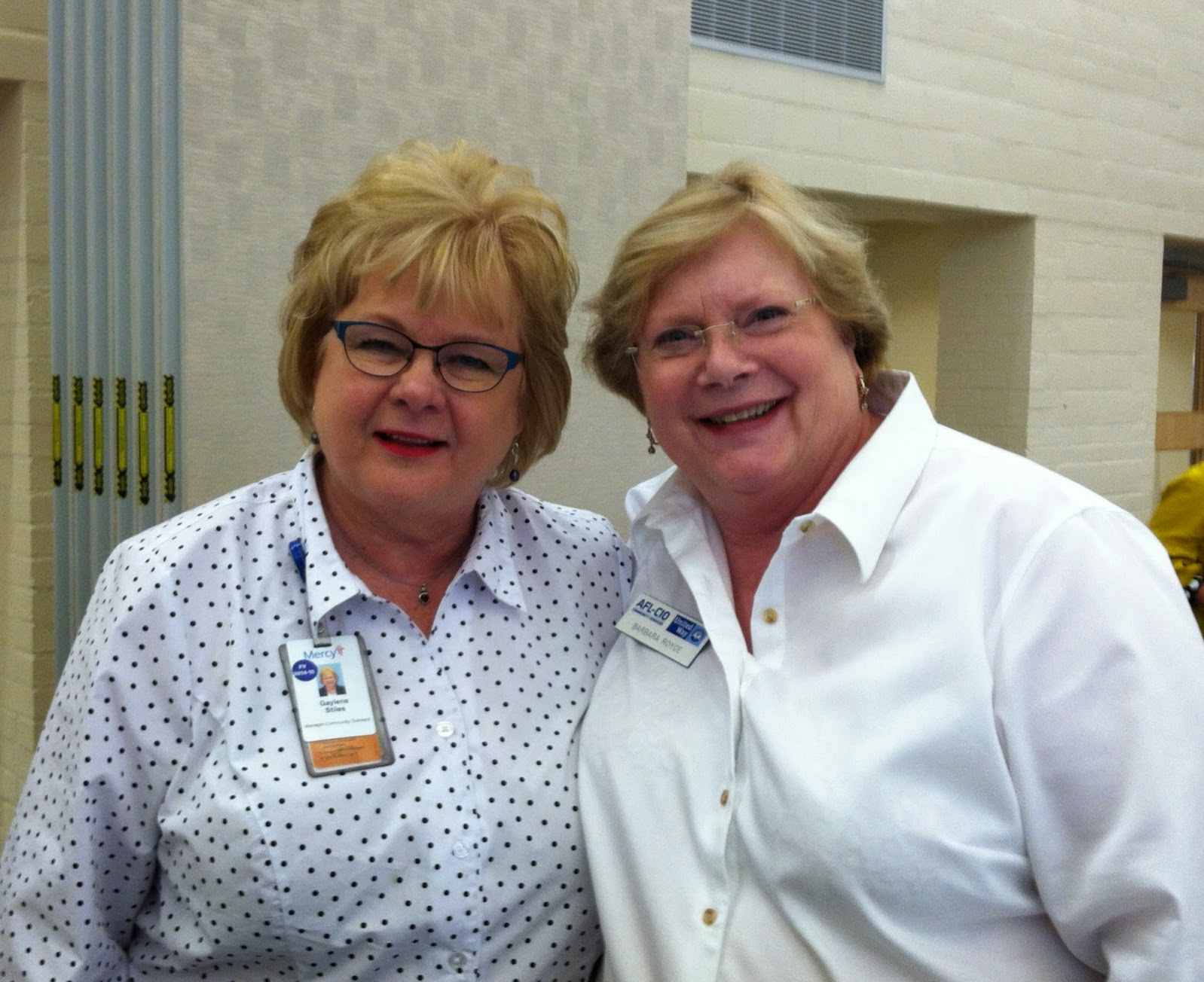
Gaylene Stiles, Mercy Health's Mentor Coordiator, and
Barbara Royce, AFL-CIO Community Services Liaison at
United Way of Central Oklahoma
Realizing she loved little girls, too, she designed a second chapter of her life, i.e., talking to young girls and women about self and their potential. 

Drawing from her own childhood, Wanda knew that she and her mother were close, but her mother had issues. A broken woman, she had worked herself to the bone rather than focusing on self to realize her potential.

Wanda talks to girls and women about who they are and who they want the world to know they are. 

To girls and young women, pregnant and unmarried or not, Wanda shows paths and processes to be successful.

“It’s not what you do but how you do it even if you have a job at McDonald’s or elsewhere,” she told the audience.

As an illustration, Wanda clasped her hands. "We’ve been clasping hands this way all of our lives. If we do it differently, after a while it feels normal," she stated.

The sacrifices she made help her touch lives—of little boys, single moms, and others as a career coach.

Anthony, her older son who works for a nonprofit, mentors in California in a group home. Kevin mentors.

Dedicated to the lives of children, Wanda reminded us that we are all in a village. Growing and nurturing young people does take an entire village. She encouraged the audience to reach out and try to make an impact on a child.

Advice
  • Be who you are.
  • Know what you have to offer.
  • Give out who you are.

Wanda is involved in the Mothers of Professional Basketball Players Association and Foundation in addition to motivational speaking and other forms of mentoring and coaching. She also is a frequent visitor to Oklahoma and Thunder basketball games.  

After her presentation, Wanda Pratt stood tirelessly, patiently, and lovingly for many photos with guests. This magnanimity was greatly tested as she posed almost endlessly for 1,000's of photos on Oklahoma Mentor Day 2015, where she was the keynote speaker.

To learn more about the incredible, genuine Wanda, see her website or wait for another post!

http://www.mamadurant.com  

Thursday, March 13, 2014

Oklahoman Who Converted Passion into Success

Dracula character photo from www.fanpop.com
A "kid," raised on a dairy farm in Atoka, Oklahoma, loved monster movies. He asked to have his mother's old makeup, although his parents were a bit skeptical. At 15, he made himself up as a character from Planet of the Apes to help a local theater promote that movie. In 1993, he won an Oscar for his makeup special effects in Bram Stokers' Dracula. Watch the video below for interviews and glimpses into Mungle's world, his studio, coworkers, and special effects. 

Discuss with your mentee(s) being different, passion, perseverance, and many other qualities that must have been necessary to propel Matthem Mungle where he is today.


Matthew Mungle
The art of Hollywood special effects makeup

http://www.cbsnews.com/videos/the-art-of-hollywood-special-effects-makeup/ 

March 2, 2014, 9:35 AM Lee Cowan introduces us to 


Lee Cowan introduces us to Academy Award-winner Matthew Mungle, one of the greatest make-up special effects men in movie history. Cowan follows Mungle as the artist goes thruogh the process of creating bodies for an episode of "CSI."      


Learn more about Mungle's work and resume at the company website for W.M. Creations, Inc., in North Hollywood.

http://www.wmcreationsinc.com/   

Looks real, doesn't it! 


Thursday, December 5, 2013

Two Youths, Different Outcomes

Brenda Wheelock, the PR director of the Oklahoma Foundation for Excellence, shared this story after she heard about Moore's speaking at "Norman AboveBullying & A Community Together" event in Norman, Oklahoma. Moore clearly represents the results of positive role models and mentoring. Mentors could share this story with their mentees.


To read more about the Norman AboveBullying event: http://www.monroepta.org/monroe-in-the-news/abovebullyingandacommunitytogether

From Oprah, April 27, 2010
Wes Moore

Same Name, Different Fate

"The similarities are striking. Two boys from Maryland were raised by single mothers in rough neighborhoods. Surrounded by drug dealers, gun violence and gang activity, each man struggled to make a name for himself. The name? Wes Moore.

These men may share a name, but they had very different destinies. One Wes Moore is a Rhodes Scholar, a White House fellow and a Wall Street hotshot. The other Wes Moore was convicted of killing a police sergeant and will spend the rest of his days in a 6-by-8-foot prison cell."

Read more: http://www.oprah.com/oprahshow/Two-Men-Named-Wes-Moore-Two-Fates_1#ixzz2mYLW0Npl

Monday, July 29, 2013

STEM and Golf, Ping Pong?

Besides the importance of STEM in his win and in his teachers' academy, Phil Mickelson talks about resiliency and changing his game, although he is an experienced, professional golfer. Farther below is an article about the impressiveness of Mickelson's major win with a diagnosis of psoriatic arthritis, musculoskeletal disorder causing autoimmune issues and sometimes crippling.  Mickelson is a role model to discuss in several ways.

Segment: "It's Phil Mickelson vs. Matt Lauer...at ping pong"

"Golfer Phil Mickelson talks about coming back from behind to win the British Open, saying "he had to change a lot of his game."  He talks with TODAY's Matt Lauer in a game of ping pong."

Lauer:  "If you're a fan of golf, the man with us needs no introduction.  Phil Mickelson, his latest over the weekend, an incredible come from behind vicory at the British Open."

Lauer: "Raise your hand if you've had a pretty good couple of weeks."

Mickelson: "It's been an incredible couple of weeks. The two weeks in Scotland having Amy and the kids there has made it so special, but actually this week, the week after the British Open, is one of my favorite weeks of the year becasue Amy and I for the ninth year now partnered with Exxon Mobil to create a teacher's academy, and we're passionate about math and science, and math and science played a huge role in winning this cup. I had to work with engineers to get spin off of my tee shots in this win and that three wood I hit on 17, the two shots were the two best of my life I couldn't hit a year ago."

Lauer: "Talk to me abou the fact that--there was a time in your career where you were known as a guy that came down to the final round, had a chance to win, you'd hit one wacky shot or take one risk that people didn't think you should take, and it would slip away. You're not that guy anymore. What's the biggest difference?"

Mickelson: "Well, first, just saying that it was only one shot is very nice of you. Thank you."

Lauer: "You're my guest."

Mickelson: "...you know, I am trying to go out and win tournaments, and if I fail, I fail. If I succeed, that's great. My worst, hardest loss of my career was the U.S. Open just a month ago, and for days I didn't get out of bed. I was tired. It was a trip we had to Montana that got me out of my funk, and I realized that I'm playing great golf. I can't let one loss affect the rest of the year, and I was able to turn it around and make one of the greatest high of my career."

Lauer: "You're going to the hall of fame in golf. 'No question about that. I watched you hugging Amy and the kids after the win at the British Open, and I want to ask you a different-sided question. If your kids get asked in five years about you, and they're not allowed to talk about golf, what do you want them to say?"

Mickelson:  "Well, I love what they said when they were asked about me. They said he's just always been dad to me, and now they're actually seeing me play well and win big championships at an age they can understand what's going on. And so it's a unique dynamic because they have always just seen me as dad, and that's what I hope in five years they continue saying."

Lauer:  "'So many emotion moments. I love watching "Bones" [Jim Mackay], your long-term caddie, break down in tears. Are you as proud of the win or the way you won?"

Mickelson:  "This is the greatest accomplishment of my career. The one tournament that I had to change a lot of my game and practice hard to develop the skills to win this British Open and to play the best round of my life and the greatest last eight holes to capture this is what is so rewarding."

Lauer:  "You talk about skills. I want to walk with you because you also mention the Mickelson Exxon Mobil Teacher's Academy, and in a strange way you're telling me that the game of ping-pong plays into it."

Mickelson:  "We're teaching action and reaction and motion in forces.

Lauer: "I need a lefty paddle. Go ahead."

Mickelson:  "So we're using all of these motions that we talk about in our academy. Right now we're using face angle, we're using spin, and if I put back spin like that, it rolls off the paddle into the net. If I put top spin like this, you have to watch it. So it might go long. So you have to adjust the face angle of your pattern based on what I'm doing.  That's backspin, and its going into the net."

Lauer: "In other words, teaching kids and teachers with things they can identify with, that come into their every day lives."

Mickelson: "That's it. So we're trying to give them new innovative techniques to inspire their students and use abilities so that they're involved in the learning progress rather than just telling them from a textbook."

Lauer: "'Nice shot."

Mickelson: "I saw that back spin."

Laurer: "'Most importantly, continued success with the teachers' academy, and keep lighting it upton golf course. Phil, we're proud of you."

http://www.today.com/video/today/52586492#52586492
Ret. 7-26-13

Phil Mickelson: Technology was key to my British Open win 

"Phil Mickelson: Lack of technology education hurts U.S."    (CNBC video)
[Mickelson explains how engineering/science helped him and also about the academy.]
                
Published: Friday, 26 Jul 2013 | 11:02 AM ET
 
http://www.cnbc.com/id/100917079

Phil Mickelson's win with psoriatic arthritis made me appreciate him all the more


http://www.golf.com/tour-and-news/phil-mickelsons-wins-first-major-after-psoriatic-arthritis-diagnosis   Ret. 7-26-13

Links to Mickelson/ExonMobil Teachers Academy 
http://mickelson.nsta.org/

Photo: Amy & Phil Mickelson

Monday, May 13, 2013

Inspiration: Sidney Poitier's Story

'Why read and share?  'Because this is an incredible story of stunning achievement by a young man who could barely read, had a thick accent and did not realize all against him.  Early in life, he decided upon responsibility and a behavioral code.  An elderly Jewish man, a mentor, taught him to read. 

This is one of those true inspirational stories that should be shared and discussed, especially between mentor and mentee or within a group. 

The CBS photo gallery has many photos of Poitier's career, which young people should see, but for the blog post, we have borrowed a current photo from the interview and also a gallery photo from 1965.  The link to the video interview and photos is below the verbatim transcript.


May 12, 2013 10:18 AM
The dignity of Sidney Poitier

(CBS News) The word "Legend" seems custom-made for actor Sidney Poitier, who has been making his presence felt on and off the screen for more than 60 years now. And he'll be telling Lesley Stahl this morning . . . his work is far from done:

 
Sidney Poitier's life has been a series of "firsts."
In 1958, he was the first black actor nominated for an Oscar as Best Actor for his role as an escaped convict chained to Tony Curtis in "The Defiant Ones."

He was the first black man to kiss a white woman in a movie, 1965's "A Patch of Blue."

And when he won the Best Actor Oscar in 1964, he was not only the first black actor to do so, he remained the only one until 2002.

After starring in more than 50 movies, Poitier says his career choices were less about being "first" and more about the image of his characters.

He would not, he told Lesley Stahl, play someone who was immoral or cruel. "If you go through my career, you'll find that I didn't. I didn't ever."

His typical character was dignified, proud, and ethical.

Take Virgil Tibbs, a Philadelphia homicide detective who reluctantly helps a small town police chief in Mississippi, played by Rod Steiger, solve a murder, in "In the Heat of the Night."

But before signing on to play the role, Poitier asked the movie studio for a major script change to one scene in which his character is slapped:

"I said, 'If he slaps me, I'm going to slap him back. You will put on paper that the studio agrees that the film will be shown nowhere in the world, with me standing there taking the slap from the man.' "

"God, you had this written into the contract?" Stahl said.

"That's right, written into the contract," he replied.

"And of course it is one of those great, great moments in all of film, when you slap him back."

"Yes, I knew that I would have been insulting every black person in the world [if I hadn't]," Poitier said.

One critic noted that the slap represented "the repressed wrath of the black man for his American bondage."

"I did not go into the film business to be symbolized as someone else's vision of me," Poitier said. He said he would not take any part "that reflects negatively on my father, my mother and my values.

"My father was a tomato farmer. There is the phrase that says he or she worked their fingers to the bone, well, that's my dad. And he was a very good man."

The youngest of seven children, Sidney Poitier was born three months premature while his Bahamian parents were in Miami to sell tomatoes.

Uncertain whether he would survive, his dad purchased a tiny casket, while his mother consulted a palm reader . . .

"The lady took her hand and started speaking to my mother: 'Don't worry about your son. He will survive,' " Poitier recalled. "And these were her words, she said: 'He will walk with kings.'"

And it came true: "Everything she said, including walking with kings, yeah."

Sidney lived in the Bahamas until the age of 15, when his parents -- afraid Sidney was on a path to delinquency -- sent him back to Miami to live with his older brother. But at 16, Sidney left for New York, where he tried his hand at acting, even though he'd had only two years of schooling.

"You couldn't read, you had a very thick Bahamian accent, and you decide to try and become an actor? Why did you go that route? It kind of makes no sense," said Stahl.

"I had no way of knowing that there is a madness to what I'm trying to do," he said.

After a disastrous audition with the American Negro Theater, where Poitier could barely read the script, an act of kindness at his job as a dishwasher changed his life.

"There was one of the waiters, a Jewish guy, elderly man, and he looked over at me and was looking at me for quite awhile. I had a newspaper, it was called Journal American. And he walked over to me, and he said, 'What's new in the paper?' And I looked up at this man. I said to him, 'I can't tell you what's in the paper, because I can't read very well.' He said, 'Let me ask you something, would you like me to read with you?' I said to him, 'Yes, if you like.'

"Now let me tell you something: That man, every night, the place is closed, everyone's gone, and he sat there with me week after week after week. And he told me about punctuations. He told me where dots were and what the dots mean here between these two words, all of that stuff."

"He took you through high school," said Stahl.

"Yes, he did. And it wasn't for long. I learned a lot. And then things began to happen."

Like landing an acting apprenticeship with the very same theater company that had laughed him out of his audition.

There, Poitier learned alongside actors like Ruby Dee, Ossie Davis and Harry Belafonte.

And then in 1950, he was cast in "No Way Out," as a doctor facing overt racism from a prisoner played by Richard Widmark.

Even at the beginning of his career, he was insisting that he portray men who were upright, well-educated, and often of stronger character than the whites around him.

"Well, that was my responsibility in terms of my value," Poitier said. "If the screen does not make room for me in the structure of their screenplay, I'll step out. I'll step back. I'd step back. I couldn't do it. I just couldn't do it."

By 1967, Poitier was among the top ten Hollywood moneymakers, and a top ten leading men. In that one year alone, he starred in "To Sir, With Love"; the Oscar-winning "In the Heat of the Night"; and "Guess Who's Coming to Dinner," with Spencer Tracy and Katharine Hepburn.

But that year he began to face criticism from some in the African American community, who labeled him an "Uncle Tom" for the "purity" of his roles.

"And it didn't hurt you?" asked Stahl.

"Hurt me for what?" he replied. "I have no objections to the other people, even though I disagree with their point of view, and I don't disagree with their point of view and chastise them - I just simply say, 'I live by a certain code.' I have to have a certain amount of decency in my behavioral pattern. I have to have that. That is my responsibility.

"So what those people say, they have to speak for themselves. They don't have to speak for me, particularly speak for me, 'cause I've been speaking for myself."

In the 1970s, Poitier turned to directing. And surprisingly, the actor who so often personified elegance, grace and earnestness, directed comedies, with slapstick, including "Uptown Saturday Night" and "Stir Crazy."

In the 1980s, he turned to writing books, producing three autobiographies about himself and his family of six daughters, grandchildren and great-grandchildren.

And now, at age 86, after a lifetime of accolades, Poitier has written a novel, called "Montaro Caine."
He spent years writing in long hand and on the computer. "Wow, it took me a very long time."

It's two genres mixed together: mystery and science fiction. For Sidney Poitier, the novel is a chance to reflect on life and all its meanings.

"I was not intending to make an impression on the people who would read the book," he explained. "I was finding release for myself within myself. I was looking for who I am at this point in my life."

"Did you find out?" Stahl asked.

"Somewhat, yes."

"Who are you?"

"I'm a good person," Poitier replied.

http://www.cbsnews.com/8301-3445_162-57584073/the-dignity-of-sidney-poitier/   Ret. 5-13-13

Wednesday, May 8, 2013

Sir Richard Branson's Inspiration

Sir Richard Branson's Inspiration

Eric Schurenberg | Inc.com staff

Mar 11, 2013

Branson's first hero was one of the most determined men of the 20th century. It tells you something about Sir Richard's own approach to business.

 
Popperfoto/Getty Images

Group captain Douglas Bader, pilot in the RAF during the Battle of Britain in World War Two, 1950.


Last month, I was lucky enough to spend an hour with one of the greatest entrepreneurs of all time, Richard Branson. Among much else, I learned one little-known aspect of the Branson origin story--namely, his boyhood inspiration.

That was one Douglas Bader, a Battle of Britain hero, Branson family friend, and possibly the most determined man of the 20th century.

Bader lost both legs in a flying accident in the 1930s. He not only taught himself to walk on artificial legs, without so much as a cane, but also to play scratch golf and to fly fighter planes well enough to become a top British ace. When Bader was finally shot down over German-occupied France, he lost one of his prosthetic legs. After his captors allowed a replacement to be airdropped to him, he rewarded their chivalry by promptly climbing out the third-floor window of his prison hospital and escaping.

It may not be exactly a straight shot from Bader's tin knee to the Virgin Group boardroom, but every founder needs inspiration. Branson took his from a boyhood idol. Many Inc. 500 CEOs tell Inc. that they got their inspiration from their father or close male relative. Cosmetics queen Bobbi Brown, for example, says she learned everything from her grandfather Sam Shatten, a Russian immigrant who became one of the most successful Cadillac dealers in Chicago."My grandfather taught me always to have your eyes open," she says, "because you never know what oppportunities are going to come your way."

For many entrepreneurs, of course, the inspiration comes from Sir Richard himself. No wonder: To launch his first successful company at the ripe age of 16, Branson overcame dyslexia, shyness (a problem he has clearly outgrown), and a doubting father who wanted young Richard to stop talking rubbish about entrepreneurship and become a lawyer like him. "Whenever you have an idea," Branson told me, "99 percent of people are going to tell you it won't work." In the end, young Branson decided, "Screw it; just do it," his five-word audible for making a leap into the unknown, as every entrepreneur eventually must.

Branson's history should remind you that even he once had nothing to go on but chutzpah and the example of a hero so indomitable that he refused to let a crippling injury keep him from what he loved. May that give you the inspiration you need--as we all do, from time to time--to screw it, and just do it.


Eric Schurenberg is the editor-in-chief of Inc. Before joining Inc, Eric was the editor of CBS MoneyWatch.com and BNET.com and managing editor of Money Magazine. As a writer, he is a winner of a Loeb and a National Magazine Award. @EricSchurenberg
 
http://www.inc.com/magazine/201303/eric-schurenberg/sir-richards-inspiration.html

Ret. 5-6-13

Friday, February 8, 2013

Governor Fallin Makes Mentoring Video


Governor Mary Fallin was gracious to make a video PSA to promote youth mentoring for Oklahoma's Year of Mentoring.  We thank Governor Fallin and her video team for their time, expertise and kindness. 


L-R: Nick Betz, Kevin Lowe, Eric Leslie, Governor Mary Fallin, Mat Miller and Bart Vleugels


Tuesday, July 24, 2012

Role Models, Activities

Whether or not you are interested in sports or the Olympics, Olympic athletes often have amazing stories, which can be shared learning moments.  Research and discuss with mentees.

Allyson Felix, Olympic gold or bust”
Tweet from her mother whenever she is going somewhere:  “Remember who you are.”
 http://video.today.msnbc.msn.com/today/48298473#48249104


“Three Olympians to watch for”  
Michael Phelps, swimming in his third Olympics
John Orozco, Puerto-Rican American gymnast, 19-years-old from a poor but hardworking family
Maher Abu Rmeileh, Palestinian, Judoka judo competitor, sells head scarves in the market.
From guest commentators on the same show:
Sarah Robles, female weight lifter, just received one sponsor, not the “type” to endorse products; persevered even without external money; her signature quote: "Beauty is strength."
Oscar Pistorius, amputee sprinter who fought so hard to compete at the Olympics
Brady Ellison, recurve archer
Rock Center “Gymnast Gabby Douglas on Olympics:’I’m going to do this thing’”
Sixteen-years old, dubbed the “Flying Squirrel,” almost abandoned her dream 


“Somalia athletes dream of Olympic gold:
Mogadishu runners Mohamed and Samsam train on dusty, dangerous streets with bullet-riddled buildings along the way.  Samsam’s home is not even what we would call a tent—superb example of discipline, dream, overcoming obstacles! 
http://video.today.msnbc.msn.com/today/48298473#48225438

“Somalia’s athletes brave war to train for the Olympics”
Islamists killed the head of the Somalian Olympic team.  Read this article for much more. (video)
http://www.channel4.com/news/somalias-athletes-brave-war-to-train-for-the-olympics

Natalie Coughlin: ‘I’m older and much, much wiser’”
Eleven-time medalist, now 29 competing against much younger women
http://video.today.msnbc.msn.com/today/48298473#48224846

Team USA website:  http://www.teamusa.org/Athletes.aspx

All retrieved 7-24-12

Friday, July 20, 2012

Role Models - Amputees

Overcoming any major differences--whether physical or emotional or sometimes both--requires much from within.  Learn/teach from these stories.  (What a series of lessons these can be--discuss the science and technology, special movie effects, mind over matter, alternate ways of viewing selves and situations, regaining a positive attitude, tolerance for differences, geography, and defining values such as resilience, perservance, etc.  Beverly


Spencer West, Canada
“Man who lost his legs as a child scales 19,000 ft-high Kilimanjaro by crawling on his HANDS for seven days”
Photos and article:  What is so amazing is that West had his legs amputated below his pelvis; in other words, he appears to have little or no torso from the stomach area down.  In one photo, he is wearing a tee shirt emblazoned with “Redefine Possible.”  He has!
http://www.dailymail.co.uk/news/article-2162085/Disabled-man-legs-climbs-Mount-Kilimanjaro-Spencer-West-scales-mountain-using-HANDS.html Ret. 7-20-12

“Legless Spencer West reaches Mount Kilimanjaro’s peak”
Article and videos
http://ca.news.yahoo.com/blogs/good-news/legless-spencer-west-reaches-mount-kilimanjaro-peak-152235467.html ret. 7-20-12

“A Heroic Climber with No Legs Scaled Mt. Kilimanjaro”
Spencer West, from Toronto, Canada, climbed the tallest mountain in Africa using just his hands to raise over $500,000 for Free the Children, an African charity. 
Article only
http://www.msnbc.msn.com/id/47895174/ns/us_news-giving/    Ret. 6-24-12

Oksana Masters, Kentucky via Ukraine 
“Born without legs, rower now heading for London”
Oksana Masters overcame a birth defect that left her without legs to become a world-class Paralympic rower.  Born with no fibulas because of exposure to a nuclear power plant in the Ukraine, Oksana was independent even in an orphanage.  Adopted at seven and brought to Louisville, she did not like adaptive rowing because she did not want to be labeled, but she loved the water.  U.S. Marine Rob Jones, her rowing partner, stepped on IUD in Afghanistan in 2010; like Oksana, he never looked back.  They will compete as trunk and arm rowers.   Video
http://video.msnbc.msn.com/nbc-news/48179578#48179578   ret. 7-16-12

Jason Gunter, Florida
“Double amputee trains for Ironman”
 Twenty years ago, firefighter Jason Gunter lost right arm and left leg to a boat propeller.  Now he is an attorney, husband, father, and athlete.
http://www.msnbc.msn.com/id/48202768/ns/local_news-fort_myers_fl/t/double-amputee-trains-ironman/  Ret. 7-20-12

 Geoff Turner, San Francisco
“SF Amputee Has Olympic Role Model”
Geoff Turner from San Francisco lost his leg in a motorcycle accident two decades ago.  But with prosthetic technology, he’s learned to run in marathons and more. Back then he had no role models, but now he’s got Oscar Pistorius to look up to.   [Note:  This was an MSNBC story, which has been removed.  Turner uses a running blade made by Ossur.]  Ret. 7-5-12

More on the running blade used by Pistorius and Geoff Turner, amputee marathon runner
“The Blade Runner – Oscar Pistorius” 
Chanman’s Blog
http://pamakidscoach.wordpress.com/2011/08/02/the-blade-runner-%E2%80%93-oscar-pistorius/

You will think I was scrapbooking online here, but this is an interesting story.  Read what you wish, but this man is a role model in multiple ways--double amputee, soldier, West Pointer, mentor, role model, motivator, leader, actor, African-American.  Bev

Colonel Greg Gadson, U.S.A.  
“From Army Colonel to movie star”
Resilient, Colonel Greg Gadson served and led in Kuwait, Bosnia, Afghanistan, and Iraq.  His life since has unfolded in many surprising ways, especially being cast as a hero in the movie Battleship.
In 2007 in Iraq, he was severely injured when his armored vehicle hit a roadside bomb.
At first he isolated himself, but quickly realized
I couldn’t stand quitting, couldn’t stand silence  couldn’t stand just giving up.
Col. Gaston became the first soldier to test a new prosthetic leg, went back to school to earn an MA, became co-captain of the New York Giants whom he helped motivate to the 2007 Super Bowl win.
You’re really truly not going to be exactly like you were before, and if that’s where you’re trying to go, then you’re going in the wrong direction, you’re going backwards.
Video in collaboration with The Grio, NBC’s African American news community
http://www.msnbc.msn.com/id/3032619/#47482762   Ret. 5-18-12

"Double amputee soldier takes command of Fort Belvoir"
A soldier injured by an improvised explosive device in Iraq in 2007 became the first double amputee to take command of a major military installation, the Army reported on its home page on Wednesday.  
http://usnews.msnbc.msn.com/_news/2012/06/27/12441438-double-amputee-soldier-takes-command-of-fort-belvoir   Ret. 7-20-12

“Col. Greg Gadson takes over Fort Belvoir command”
Col. Gadson becomes the leader of a 46,000 soldier installation—the first time an amputee has been promoted to base commander.  This video and article mentions he was a mentor/advisor and honorary captain of the New York Giants.
http://www.wjla.com/articles/2012/06/col-greg-gadson-taking-over-fort-belvoir-command-77138.html   Ret. 7-20-12

“Army Col. Greg Gadson serves as inspiration as Giants make Super Bowl run”
http://www.wjla.com/articles/2012/02/army-col-greg-gadson-serves-as-inspiration-as-giants-make-super-bowl-run-72205.html   Ret. 7-20-12
"Col. Gregory Gadson in Battleship"
Fighting external battles in the movie, Mick learns the real fight toward becoming a full man -- is in his soul. It’s a lesson Gadson learned in Iraq.
When your whole life is turned upside down, you’ve got to reorient yourself and find your dignity… your energy and…your respect.  Those are real life struggles.

"Black Amputee In Battleship Movie Lost Legs In Iraq"
This video has more of the action clips from the movie and filming behind the scenes so it would appeal to youth visually. 
http://theurbandaily.com/1922852/greg-gadson-battleship-ready-for-action/   Ret. 12-12

"Col. injured in Iraq lands role in Battleship"
‘Interesting information about his prosthetics as well.
http://www.armytimes.com/news/2012/05/gannett-iraq-vet-battle-battleship-hollywood-movie-051712/     Ret. 7-12-12

Wednesday, July 11, 2012

Role Model

Mentoring began early in this successful business woman's life, but she was later mentored in the workplace where she subsequently developed a professional mentoring program.  Mentoring produces endless ripples.  Beverly

My Mentor: Home Depot CFO Talks About People Who Inspired Her
By: Caroline Wilbert

Carol Tome grew up in a small Wyoming town and is regularly recognized as one of the country’s top female executives. Tome, chief financial offer and executive vice president of corporate services at Home Depot, says that each leg of her journey has been marked by great mentors, starting in childhood with her mother and grandmothers. Tome chatted with DivineCaroline recently about some of the mentors who helped her get to where she is today.

Q: Can you talk about a mentor who had a big influence on you?

A: I am lucky to have had a lot of great mentors, all the way back to my mother and my grandmothers. I grew up in a town of 3,000, in Jackson Hole, Wyoming, and now I am the CFO of the fourteenth largest company in the country. I give a lot of credit to them for instilling self-worth and confidence in me. I never worried about the way I looked. They told me, “You are wonderful. You can do anything.” And I believed them.

Q: Were they working women?

A: My mother was a schoolteacher until she had children and then she was a stay-at-home mom. My maternal grandmother lost her husband when she was in her thirties, so she worked. My paternal grandmother didn’t work, but she graduated from the University of Michigan in the early 1900s. They were strong women, very involved in their community, very financially savvy.

Q: What about professional mentors?

A: After grad school, I went into the training program at the largest commercial bank in Colorado. This was 1981. One of my mentors was an executive there, a woman, which was very unusual, particularly at a commercial bank. Her name was Mary Louise, but she went by M.L. Nobody outside the bank knew from her name that she was a woman. She was tough. She was really influential on me, partly because she had done so well in an environment not really geared to women. She had spunk and tenacity. We would go out—I don’t do this anymore—but we would go out drinking scotch on the rocks. I was just keeping up with her. Even then, I knew I was going to have ups and downs and it was important to have the kind of tenacity that she had.
Q: Is there any advice that one of your mentors gave you that has stuck with you?

A: It is important to have bosses that will tell you, “This is where you excel, and this is where you de-rail.” Jim Colgate told me I had great passion, but he also told me, “You get too angry. Your anger will de-rail you.”

Q: Do you think about that advice now?

A: All the time.

Q: Any other specific advice?

A: I observe people all the time. I have learned a lot by watching people, about what to do and what not to do. Leadership is not about position; it is all about action. I had a boss who got mad at someone and threw a piece of paper down the table. That was really destructive and I learned that I didn’t want to act like that.

Q: What about at Home Depot?

A: I joined The Home Depot in 1995. (Former) board member Faye Wilson took me under her wing right away. She was tremendously supportive. She was always talking me up.

Q: Is it important for women to mentor each other or do you see mentoring as gender neutral?

A: I used to say it didn’t matter, that gender-neutral was fine. Now I think it does matter. That is why I started a mentoring program for women at The Home Depot, for executives at the director level and above, called the Velvet Hammers.

First published May 2007
http://www.divinecaroline.com/22278/29594-mentor-home-depot-cfo-talks#ixzz1tjd84LXc
ret. 5-1-12

More recent article more focused on her business leadership:  http://www.businessweek.com/magazine/content/11_04/b4212064704660.htm   ret. 7-6-12

Note:  Tome is also the 2012 Metro Atlanta Chamber of Commerce Chairman!