Showing posts with label Recruiting Mentors. Show all posts

Friday, April 28, 2017

Recruiting for Kids from Hard Places

Several years ago, Tulsa Boys' Home had six mentors. Then mentors increased to about 110, although hundreds of other people have been trained, undergone background checks ($53 each), and approved by the Department of Human Services to work with the boys there on a regular basis. During the past 30 months, TBH has recruited 158 new mentors. 

Goals set by the organization as part of Tulsa's Vision 2020 are for the home to be self-sufficient and for each boy who wants a mentor to have one. Tulsa Boys' Home is well on its way to achieving its goals.

First, a little background from the TBH website. 


Each day, Tulsa Boys' Home delivers residential services to 64 boys and their families (when there is a family). Forty of our residents are placed by the child welfare division of the Department of Human Services, and the other twenty-four are privately placed by parents or legal guardians in our Substance Abuse Treatment Program. Since 1918, we have helped over 12,000 boys, many of whom have learned to lead happy and productive lives. Most credit TBH for breaking the cycle of poverty, abuse, neglect, and drug addiction from one generation to the next. Therefore, our work of healing and new found hope is multiplied many times over through countless families and the children of the children that once lived, and were healed, at Tulsa Boys' Home.
http://www.tulsaboyshome.org/tulsaboys/default.asp  


Jeff Johnson, youth minister and volunteer coordinator, for the TBH, shared the basic strategy for gaining so many volunteers and mentors. Although this is a highly adaptable model for similar other programs reaching highly at-risk youths, we can all learn from Tulsa Boys' Home.


TBH recruiting is slow and steady. Johnson gives much credit to the Tulsa community, especially the faith-based population, which has demonstrated caring and concern not only for Tulsa Boys' Home but also other organizations serving youths.

Asking some men to volunteer as a mentor once a week for a year is intimidating. People are busy and may not wish to commit that much time. Next year, however, their children may have graduated, and the volunteers have established some rapport with a particular young man and wish to mentor him.

Ask friends to volunteer. Also ask groups, such as Sunday school or church groups. For example, Life Church in Tulsa has 175 volunteers and/or mentors. Asbury United Methodist, First Presbyterian Church, the Church at BattleCreek in Broken Arrow, and others volunteer consistently. Currently, the home has 500-600 volunteers. Of the 64 residents, all boys eligible to have a mentor have one. 

Establish dozens of small, scheduled opportunities for regular interaction and growing mentoring. Another example of an activity is on the second Tuesday of the month from 6 to 8 p.m., volunteers are invited to fly kites or participate in another activity.

Give trained mentors and volunteers something to do. Don't let them languish or search for an activity. 

Invite them to do what they love to do, e.g., beginning a running club this year that meets on Thursdays at 6:30 p.m. 

Establish dozens of small, scheduled opportunities for regular interaction and growing mentoring. Another example of an activity is on the second Tuesday of the month from 6 to 8 p.m., volunteers are invited to fly kites or participate in another activity.

Many volunteers, though trained, approved and background-checked, aren't assigned a boy one-to-one. They are invited to fish, play ping pong, take a boy to church, go to a sporting event, or participate in other activities. For example, a volunteer who has tickets to a sporting event will call to take one or more boys along. Often, they form a natural relationship with a youth and decide to be a weekly mentor. Regardless, the boys benefit from all of the activities and the vetted volunteers. Then when a volunteer is ready to progress to mentoring, he is immediately ready to be assigned. Waiting six weeks for a background check and training is not an obstacle.

Turnover Although some mentors move to new mentees, others usually leave at the same time their mentees move. Some boys leave and return.

http://www.tulsaboyshome.org/tulsaboys/volunteers.asp 

Some volunteers are mentors in the beginning, but many become mentors after interaction and through activities. Whether they are mentors or grow into mentoring really doesn't matter. The residents of Tulsa Boys' Home are the benefactors. 

Congratulations to Jeff Johnson and the team at TBH!

N.B.
Matt Vassar, Ph.D., a long term mentor at Tulsa Boys' Home, spoke eloquently about mentoring these young men for a previous post. 
http://okmentor.blogspot.com/2014/09/mentoring-kids-from-hard-places.html 

Wednesday, November 5, 2014

TEEM, Mentor Appreciation & Awareness

When Jenna McCullock, mentor coordinator of The Education & Employment Ministry (TEEM) reported new mentor numbers for the Coaches' Mentoring Challenge, she attributed the new mentors to an event.


TEEM uses research-based programming with lots of love and accountability to guide inmates from eighteen years old and older as they transition to build strong families and create positive futures. Mentoring is a key element of the program. 


TEEM Honors Mentors and Mentees during Mentor Appreciation and Awareness Event

Oklahoma City, OK—It was the perfect evening to be on the rooftop of Plenty Mercantile. The September air was filled with laughter, a cool Oklahoma breeze and the smell of Mutt’s Amazing Hot Dogs. The downtown Oklahoma City skyline provided a scenic backdrop as attendees shared stories of hope, restoration and friendship. On September 23, TEEM honored participants in its mentor program—an initiative designed to positively influence individuals impacted by generational cycles of incarceration and poverty in Oklahoma—and encouraged attendees to provide a hand-up to individuals reentering the Oklahoma City community.

Speaker: Patrick Raglow,
executive director of Catholic Charities 

The event honored current mentors and encouraged the community to join TEEM’s mentor program. One of TEEM’s primary organizational goals is to change the stereotypes commonly attached to formerly incarcerated individuals. Six months prior to their release from the Oklahoma Department of Corrections, the nonprofit aims to appropriately match each TEEM participant with an active mentor.

After a greeting from TEEM staff, attendees viewed a video produced by OKC Good featuring various mentor and mentee stories. They then witnessed a Q&A session between mentor Terry Dyke and mentee Dawan Brooks. After examining obvious differences, Terry and Dawan concentrated on their similarities and highlighted how the unlikely duo have formed a brotherly bond.

“If their goal was to honor TEEM mentors, I think that TEEM’s staff has truly accomplished that,” Dyke said. “I’ve never felt more appreciated in my life.”


Patrick Raglow, a retired U.S. Air Force Cornel and current Executive Director of Catholic Charities, reminded participants at the event that time is valuable. Raglow delivered a message that concentrated on the importance of doing the best with the 24 hours everyone is given each day.


Follow Raglow’s message, TEEM’s Mentor Coordinator Jenna McCullock recounted the power of encouragement in a recent volunteer experience at the Redman Triathlon and offered potential mentors a chance to play an active role by supporting participants in the marathon of life.

“Here at TEEM, we have the opportunity to cheer these men and women on,” McCullock said. “We are able to build relationships and support them as they are transitioning.”


Mentor and mentee
TEEM is an interfaith, 501(c) 3, nonprofit that exists to break cycles of incarceration and poverty in Oklahoma through education, character development and work readiness training. With a service model incorporating evidence-based curriculum, one-on-one mentoring, effective case management, occupational skills training, social services assistance and job placement services, TEEM aims to reduce recidivism rates, strengthen families and increase public safety. Approximately 8,400 inmates are released from Oklahoma’s prisons each year. Of this number, 24 percent will recidivate within 3 years of release. TEEM’s holistic approach works to change this trend by providing comprehensive reentry services to individuals transitioning out of incarceration. 

by Lance Evans, TEEM communications coordinator

For further information on TEEM’s mentor program, please contact Jenna McCullock at 405-235-5671 or via email at jmccullock@teem.org. 


For more information about TEEM, please visit www.teem.org or contact Anna Geary at ageary@teem.org.


Monday, September 15, 2014

Mentoring Kids from Hard Places

Matt Vassar, Ph.D., and Mentor
I work with a challenging population.  I work with kids from hard places.  My kids all have troubling stories related to neglect, abuse, abandonment, drugs, incarcerated parents, or academic failure.  

At some point along the way, their living environments were deemed unsafe, and these kids were removed from their homes and placed into a system of transitory living. Foster homes, emergency shelters, psychiatric hospitals, and group homes became their world.  

Imagine for a moment, a world of constant change – a new set of rights and wrongs, a new family, a new school, and a new religion every few weeks or months.  Imagine the difficulty in forming an attachment to one single person in a world where everything seems temporary.  

That’s where I come in.  I am a mentor.  

My personal ambition is to develop that relationship, to be something more permanent in a life of revolving doors and brief acquaintances.  

And it’s challenging.  

Reactive attachment disorder runs rampant.  Kids bounce from placement to placement.  Some return to their families.  Whatever the case, it can be hard to maintain a long term relationship with kids from hard places.  

But despite the difficulties, there is something special, something rewarding, and something that drives me to keep going. Perhaps it is the stories that these kids have overcome, or perhaps it is seeing an untrusting kid begin to trust again.  

Maybe it is the wisdom and perspective I receive from these kids, or maybe it is simply the ability to take a break from grown-up life and play for a while.  

But whatever it is, it drives me to want to encourage others to become mentors to kids from hard places.  

With over 10,000 kids in child welfare services, it seems to me like the need is great, yet the workers are few. I certainly don’t think that mentoring kids from hard places is for everyone. If you are picturing some idealized version of a Michael Oher story from The Blind Side, this gig is probably not for you.  

But if you are able to put aside your expectations and meet these kids at their level, on their terms, then you might be the perfect candidate. 

by
Matt Vassar, Ph.D.
Oklahoma State University Center for Health Sciences
Tulsa, Oklahoma

Matt, whose academic specialty is statistics, is a mentor at the Tulsa Boys' Home.

Personal communication, 9-5-14

Thursday, August 14, 2014

Recruiting during Welcome Week at a College

Mendy Stone, executive director of Volunteers for Youth, Rogers County, shares one effective and fun strategy.

We just spent from 10 am to 2 pm today on the campus at Rogers State University (RSU) in Claremore. This is Welcome Week, and one of their activities is to host “Big Tent Day.” 

Cindy Vanaman, PAL. Stone is holding the red cup. 
In the blue shirt is PAL Mentor of the Year 2014, Gus Ramirez.
Two big tents provided table space for all kinds of on-campus clubs, local businesses, and volunteer opportunities. 

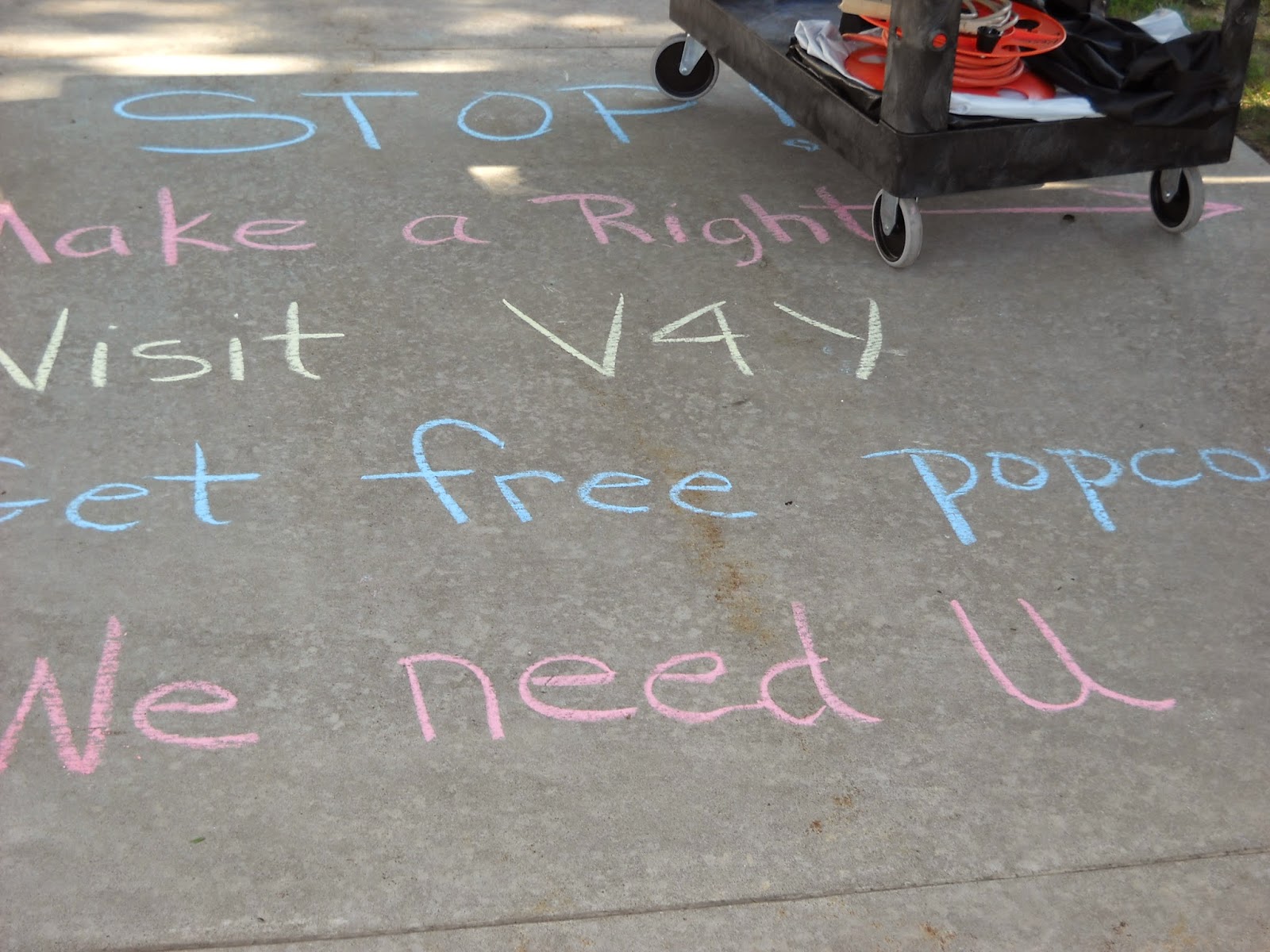
We have a good number of great prospects. We attracted them to the table with fresh popcorn, and our conversation started with 


“May we tell you about the volunteer opportunities at our organization?”

At least four of the senses are covered here!

All sidewalks lead to V4Y and popcorn!


by
Melynda Stone
Executive Director
Volunteers for Youth

Shared 8-13-14

Tuesday, August 12, 2014

Recruiting, Omaha Style

We like this idea of the city-wide mentor recruitment. What could your city or county do?
The Second Annual City-Wide Mentor Recruitment Campaign is Here!
By Whitney Mastin
August 1st marked the start of the 2nd Annual City-wide Mentor Recruitment Campaign for Midlands Mentoring Partnership (MMP). Midlands Mentoring Partnership is a Collective Impact organization that partners with 11 mentoring agencies in the Omaha area to increase both the quality and quantity of mentoring relationships.
MMP Partner Organizations:
Big Brothers Big Sisters of the MidlandsGirls Incorporated of Omaha
Hope Center for Kids
Kent Bellows Mentoring Program
Kids Can Community Center
Ollie Webb Inc.
Partnership 4 Kids
Release Ministries
TeamMates Mentoring Program
Youth Emergency Services
100 Black Men of Omaha, Inc.
In Omaha alone, there are 30,000 youth living under the poverty line. Of those 30,000, only 3000 have been fortunate enough to gain the helpful guidance and support of a formal mentor. “Our youth can grow into responsible and contributing members of society with the right supports in place, and for only four hours a month, each of us can make a significant difference,” said John Ewing, MMP Board Member. During the 2014 recruitment campaign, MMP, along with its partners, aims to recruit more than 640 additional mentors to support the youth in our community.
Quality Mentoring Relationships in the Community Can Lead to:
Fewer teen dropouts
A decrease in teen substance abuse
Fewer teen pregnancies
A more engaged workforce for businesses who have employees that mentor
On Wednesday, August 4, 2014, MMP kicked off its campaign with a press conference that included remarks from Mayor Jean Stothert, and President and CEO of the Greater Omaha Chamber, David Brown. Mayor Stothert encouraged Omaha citizens to learn more about becoming a mentor, while David Brown stated “We don’t coast—we mentor!” MMP Board President, Julie Hefflinger may have said it best when she stated, “Regardless of your background or age, the greatest gift you have to offer a young person is your genuine interest in their life and your willingness to listen attentively to them. Mentoring experiences come in all kinds of shapes and sizes, but all mentors help young people achieve their potential and discover their strengths.”
Interested in becoming a mentor? Want to learn more about the programs you volunteer for? Visit www.MentorOmahaNow.org to find out which program is best for you. You can also find more information and follow our campaign progress on Facebook , Instagram and Twitter.
http://mmpomaha.org/blog/the-2nd-annual-city-wide-mentor-recruitment-campaign-is-here/
Ret. 8-11-14

Tuesday, August 5, 2014

Workshop for Seniors

Researchers have looked at the National Guard model and then piloted an intervention. We are proud that Oklahoma has a successful National Guard Youth ChallenNGe Program, the Thunderbird Youth Academy, in Pryor.

We can learn from this research found in the Chronicles of Evidenced-based Mentoring, University of Massachusetts at Boston. The pilot intervention described below is highly adaptable for pre-collegiate students anywhere in our state.
By  July 8, 2014

Teaching Students to Recruit Academic and Career Mentors: Preliminary Results from a Pilot Intervention

Screen Shot 2014-05-13 at 8.11.58 PM
by Sarah Schwartz, Ph.D.
As we have written about before (see post), there is evidence to suggest that Youth Initiated Mentoring, as implemented by the National Guard Youth ChalleNGe Program, may be an effective approach to mentoring vulnerable adolescents
Under this model, youth nominate adults from their existing social networks to be their mentors, and then programs provide screening, training, and monitoring of the relationship, in essence, turning the relationship into a formal mentoring relationship.  We know, however, that natural mentoring relationships can be just as effective as formal mentoring relationships, or even more so. 
An ongoing question for me has been whether we might see positive impacts simply by providing youth with the training and support to identify, reach out to, and develop relationship with potential natural mentors in their lives without ever formalizing those relationships.
A pilot intervention that we recently completed at the Center for Evidence-Based Mentoring attempts to do just this. In collaboration with Urban Scholars, a pre-collegiate program for students typically underrepresented in college settings, Stella Kanchewa and I  designed a workshop for seniors in high school that aimed to teach them how to identify and connect with potential academic and career mentors. 
The workshop included lessons exploring the benefits of mentoring relationships and different types of social support and social capital, creating eco-maps (graphical representations of youth’s existing relationships) to identify potential sources of social support, and practicing how to reach out to and connect with adults (both through role-playing as well “real-world” conversations and interviews with adults in their social networks), including potential rejection. 
Since a particular focus of the program was developing academic and career mentoring relationships during the transition to college, we also focused on networking, professionalism, and “codeswitching” when connecting with adults across contexts. 
Although youth did not leave the workshop with a formal mentoring relationship, they were asked to identify an adult from their existing social network to support them during their transition to college and to explicitly discuss how and when they could reach out to that person. The workshop culminated in a “Networking Night” in which the students practiced introducing themselves and connecting with professionals from a range of fields.
Initial analysis of interviews with students suggests that such training can increase the value adolescents place on mentoring relationships and social capital, as well as developing their “help-recruiting” skills and their self-efficacy in reaching out to potential academic and career mentors. 
In addition, there is preliminary evidence that such an intervention may increase their ability to access social support from nonparental adults. In future studies, we will be collecting follow-up data to explore the longer-term influence of the workshop on students’ relationships during their first year of college. 
We are still in the very early stages of exploring this approach, but it may represent an effective strategy to facilitate the development of supportive relationships between young people and adults by allowing youth to mobilize the support of the adults in their lives.
http://chronicle.umbmentoring.org/teaching-students-to-recruit-academic-and-career-mentors-preliminary-results-from-a-pilot-intervention/  Ret. 8-5-1
Note: For the blog, we split the paragraphs to make reading easier. 

Friday, August 1, 2014

Mentor Recruiting - Big 12 Conference, et al.

Announcing Oklahoma's first year to participate in the Coaches' Mentoring Challenge 2014, we are ecstatic that OU Head Football Coach Bob Stoops and OSU Head Football Coach Mike Gundy are endorsing this mentor recruiting effort in Oklahoma. 

Coaches Gundy and Stoopts want fans, fellow coaches, staff, faculties, students and communities statewide to sign up to be a mentor. 

See the Big 12 announcement.


More information coming soon! 

Join the team. Be a mentor. 

Sign up at www.okcoacheschallenge.org.

Thursday, July 10, 2014

Recruiting Mentors, Football Style

We are so proud of Coach Bill Snyder and the Big 12 Conference for endorsing the Coaches' Mentoring Challenge 2014. Let's try to get all college and local coaches to support it, too.
Big 12 Football Coaches Join Coaches’ Mentoring Challenge
Big 12 Conference football coaches are partnering with MENTOR: The National Mentoring Partnership to join the Coaches’ Mentoring Challenge, a campaign that connects youth with caring adult mentors. The Challenge is a collective effort by leading athletic coaches to connect more caring adults and young people through quality mentoring relationships. This year’s Challenge kicks off on August 1 and runs through November 30, with final results released during the first week in December.
 
In addition to joining the effort, all 10 league coaches are challenging fans to volunteer to mentor youth in their communities. Several coaches have also teamed up with one of MENTOR’s affiliate Mentoring Partnerships and other nonprofit partners.
 
"Students in elementary, middle and high school represent our next generation of leaders, and mentoring is proven to prepare youth for excellence, effort and achievement," Big 12 Commissioner Bob Bowlsby said. "The Coaches’ Mentoring Challenge is an opportunity for our programs and their fans to support youth through mentoring."
 
"By connecting young people with caring adults we provide them with a powerful asset to achieve success in all aspects of their lives," said David Shapiro, CEO of MENTOR. "Coaches are mentors both on and off the field and they are uniquely positioned to motivate fans to become mentors. We’re grateful for the commitment of those involved and the energy brought by the Big 12 support and new coaches joining the challenge."
 
The campaign began as a friendly competition between K-State’s Bill Snyder and Nebraska’s Tom Osborne with the goal of rallying new volunteers for mentoring programs in their communities and states. Through this effort, participating coaches and universities have made meaningful contributions to the communities they call home. Since 2008, college coaches at an increasing number of institutions have demonstrated their commitment to closing the mentoring gap by participating in the Coaches’ Mentoring Challenge, impacting young people’s lives, their teams, campuses and communities.
Big 12 Football Coaches Participating in the 2014 Coaches’ Mentoring Challenge
• Art Briles, Baylor University
• Paul Rhoads, Iowa State University with the Iowa Mentoring Partnership
• Charlie Weis, University of Kansas with Kansas Mentors
• Bill Snyder, Kansas State University with Kansas Mentors
• Bob Stoops, University of Oklahoma with the Boren Mentoring Initiative, Oklahoma Foundation for Excellence
• Mike Gundy, Oklahoma State University with Boren Mentoring Initiative, Oklahoma Foundation for Excellence
• Gary Patterson, Texas Christian University
• Charlie Strong, University of Texas
• Kliff Kingsbury, Texas Tech University
• Dana Holgorsen, West Virginia University with Volunteer West Virginia

http://www.big12sports.com/ViewArticle.dbml?DB_OEM_ID=10410&ATCLID=209603125   

Friday, May 9, 2014

On Recruiting College-Age Mentors

A team from the University of Oklahoma’s Lindsey + Asp Advertising and Public Relations Agency researched, assembled focus groups, and developed a presentation to recruit college-age mentors. This information applies to other populations, too. Several of these points relate to data-gathering and data- and testimony-dissemination.


Here are their qualitative findings, which actually complement the quantitative research from Oklahoma’s First Mentoring Survey, 2013.

Passion

College students need to be passionate about their service. In sororities, fraternities, and service organizations, hours of community service are required. Service must be fun, not a chore.

Organization and Structure

The mentoring organization must have an effective structure. The entire mentoring process must be laid out with clear tasks. Students must know everything in advance. Desiring ease, they do not want to worry about administration.

Accessibility

From how to become involved to whom to contact at the school or for problems, students need information and resources. Email, social media, and websites are important for communication.

Required Hours

Fulfilling required hours must be worthwhile.

Variety of Services

What are the mentors doing? They need to know specifics, e.g., building self-esteem, improving academics, developing social skills, teaching conflict resolution, resolving anger, and so on.

Impact of Mentors on Mentees

College students want to know what their time spent actually yields. For example, this is your mentee, and this is how he or she has improved.

Importance of Mentoring

Who has benefited from mentoring? International, national, state, or local former mentees--sometimes celebrities--to whom they may relate are helpful. Anecdotes can also illustrate the results of mentoring. This is part of the emotional appeal.  

Variety

Mentors come from a wide variety of backgrounds, ages, ethnicities, socio-economic levels, etc. Freshmen through graduate students mentor. Some 2013-14 Boren Mentoring Initiative mentors' majors include engineering, pharmacy, microbiology, biochemistry, business, advertising, psychology, agricultural education, history, and health and exercise science. 

In Oklahoma, the youngest organized mentors are high school age, and the oldest are in their nineties. Mentors range from custodians to CEO’s and company chairmen. Almost anyone can be a mentor, and often those who thought they could not mentor are the best.

Expectations

Requirements, issues, processes, accountability, training, commitment, resources, activities, problems, closure, help, and other components of mentoring must be revealed. Nothing should be hidden or glossed over just to sell the program.


We thank Nick Howard and Colleen Owen for all of their time and expertise for this information and the other work they have led and executed on behalf of the Boren Mentoring Initiative.

Nick Howard
Advertising Senior 2014, University of Oklahoma 
Lindsey + Asp Advertising and Public Relations
Account Lead/Strategist 

Colleen Owen  
University of Oklahoma
Advertising/Film & Media Studies
Lindsey + Asp Project Manager
Integrity Council Member

Lindsey + Asp is a student-led, professional PR firm at the University of Oklahoma.
http://lindseyandasp.com/ 
                                                                                              

Phone conversation, May 8, 2014

Friday, May 2, 2014

Become a Mentor!


from the 2014 National Mentoring Month Campaign sponsored by

MENTOR National Mentoring Partnership
Corporation for National and Community Service
Harvard School of Public Health
Office of Juvenile Justice and Delinquency Prevention (OJJDP)
United Way

Friday, April 25, 2014

Five Ways to Ensure Mentoring Quality


from the 2014 National Mentoring Month Campaign sponsored by

MENTOR National Mentoring Partnership
Corporation for National and Community Service
Harvard School of Public Health
Office of Juvenile Justice and Delinquency Prevention (OJJDP)
United Way

Thursday, April 17, 2014

Why Mentoring Works


from the 2014 National Mentoring Month Campaign sponsored by

MENTOR National Mentoring Partnership
Corporation for National and Community Service
Harvard School of Public Health
Office of Juvenile Justice and Delinquency Prevention (OJJDP)
United Way

Wednesday, March 5, 2014

Tulsa's Partners in Education: About Mentoring

Note the different forms of mentoring suggested by the Tulsa 
Partners in Education program. All are applicable in any town. 

City of Tulsa joins Partners in Education program

Posted on: February 28th, 2014
The Honorable Dewey F. Bartlett, Jr., Tulsa Mayor, First Lady Victoria Bartlett and school leaders on Friday inaugurated the city of Tulsa’s new partnership with Emerson Elementary School, wherein city employees are being asked to spend their lunch hour with Emerson students weekly as part of the Partners in Education program.
The announcement was made at the Mentoring to the Max Breakfast with Dewey Bartlett, where the Tulsa region’s top mentoring leaders and organizations — including Junior Achievement, 100 Black Men of Tulsa and Skills USA — came together to describe how even an hour of one-on-one time with a child can have a dramatic impact on academic performance, behavioral tendencies and overall well-being.

A key component of the Partners In Education program, mentoring is a free and easy way to boost volunteerism and general well-being among your company’s employees, improve community standing and help make a difference in the lives of students. Mentoring can take a number of forms, including:

  • A regular but brief one-on-one session with a student in which a mentor visits informally with the child. Discussion topics might include schoolwork or the child’s home life, but regardless of the topic, the mentor acts as a responsible friend. Just having a stabilizing adult presence can boost a child’s grades and instill self-confidence.

  • Lunch buddies. An even more informal one-on-one mentor relationship, lunch buddies need only spend one lunch hour a week with a student in a friendly lunchtime environment.

  • A one-time “career presentation” to a classroom. Students can benefit from hearing the perspective of a member of the workforce regardless of profession. Exposure to different professions and potential careers can give a child direction in life.

  • Opening up a workplace to guided tours for students. Much like career presentations to classrooms, workplace tours can be a powerful influence on a student’s career choices.

Email Chamber Education Program Manager Kuma Browne at kumabrowne@tulsachamber.com for mentor opportunities.