Showing posts with label Healthy Lifestyle. Show all posts

Friday, August 8, 2014

Preventing Teen Pregnancy

Mentoring organizations can train with mentors to address prevention of teen pregnancy. As the Oklahoma teen birthrate suggests, just expecting or demanding abstinence does not work. Education is a critical key for male and female mentees.


Prevention key to combating teen pregnancy


From left highschool students, Micayla Thibodeaux (17) and Chase Gulliver (17), present a Teen EmPower class to 7the graders at Delcrest Middle school with Exec Director Kathy Harms. (Shannon Cornman)
From left highschool students, Micayla Thibodeaux (17) and Chase Gulliver (17), 
present a Teen EmPower class to 7the graders at Delcrest Middle school with Exec 
Director Kathy Harms. (Shannon Cornman)
The truth
One ounce of prevention is worth a pound of cure, or in this case millions of Oklahoma tax                   dollars each year. In 2010, the state of Oklahoma spent $169 million on teen childbearing.             However, very little money is allocated for expanding education to prevent teen pregnancy.

“Many nonprofits are about reacting,” said Kathy Harms, executive director and founder of            Teen EmPower. “They are spending time and resources working with pregnant teens, and                   I say let’s back up a bit. Let’s try to increase education so the teen doesn’t end up in the           situation.”

Ten years ago, Harms began Teen emPower with the focus of preventing adolescents from                     taking part in high-risk actions through youth education.

“We need to take a prevention approach,” Shanté Fenner, education and training director                     at Oklahoma Institute for Child Advocacy, said. “We educate on the importance of wearing                 seat belts. We talk about the reasons why we shouldn’t smoke. Why would we want to                       prevent teaching accurate information on this topic?”

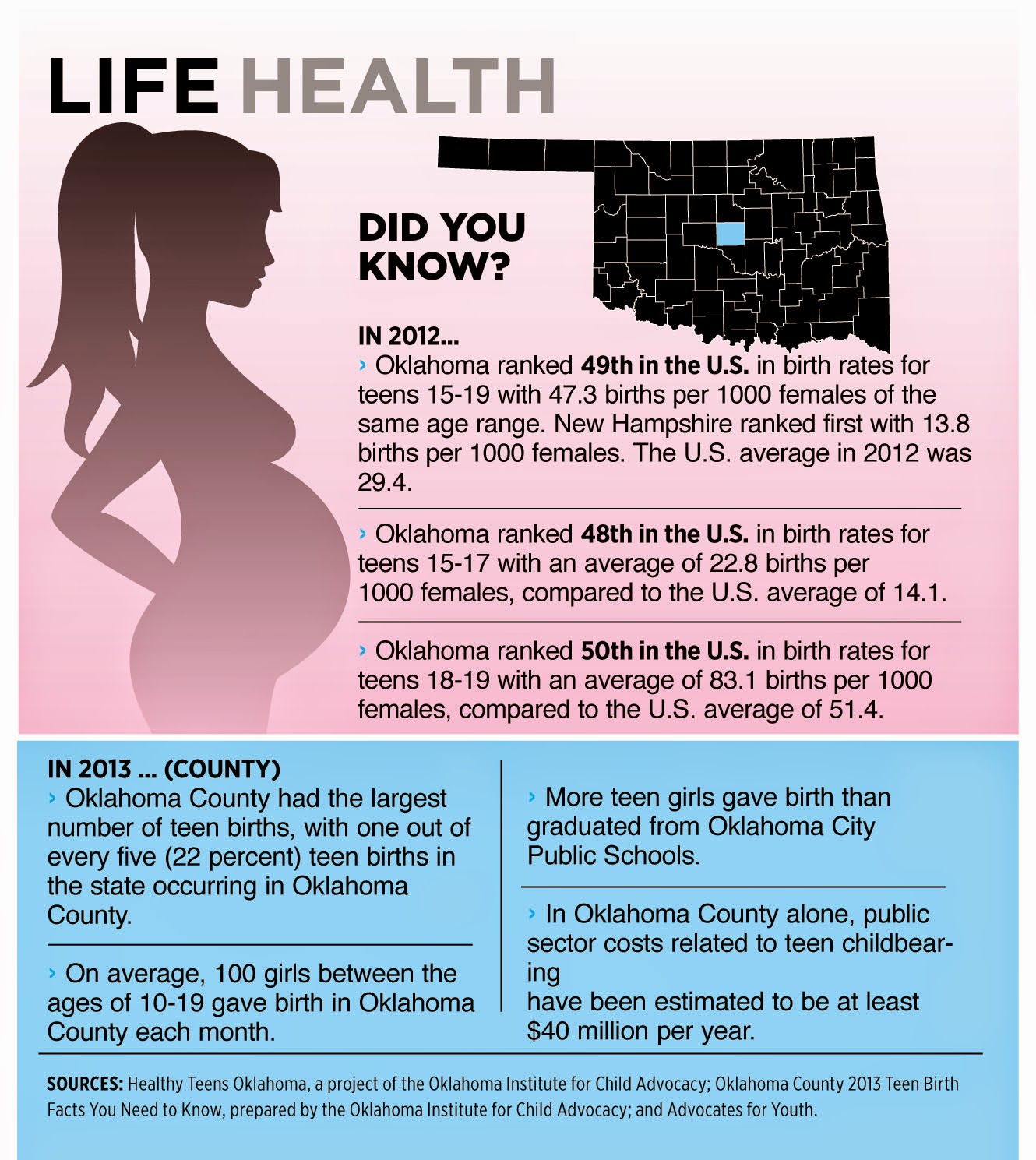
Overall, teen birth rates are going down. Six years ago, Oklahoma had 7,581 births to girls               ages 19 and younger; in 2013, the state had 5,379 births to girls ages 19 and younger — a 29       percent decrease.

However, to put that into perspective, more 18-19-year-olds in Oklahoma gave birth in recent       years than entered the University of Oklahoma and Oklahoma StateUniversity as freshman.
“The teen birth rate in Oklahomahas ranked too high for way too long,” said Sharon Rodine,        youth initiatives director at the Oklahoma Institute for Child Advocacy. “The benefits of        preventing youth pregnancy are enormous. Other challengessuch as child neglect, poverty,           even unemployment can be affected by this. The good news is that this is preventable.”

Currently, there is not a teen pregnancy rate because there is no way to accurately track       pregnancy rates. However, what is monitored is teen birth rates, and in 2012, Oklahoma             ranked 49th in the country — just ahead of New Mexico — for the highest teen birth rate of             girls ages 15-19 and 50th (the highest and worst) in the country for ages 18-19.
“In our country, we do poor job of discussing sexuality with young people. And as a             result, we have the highest rate of teen births of any of the industrialized nations in                    the world, and for many sexuality transmitted diseases,” Harms said.
Not really reality
Reality television, music and filmpromote or even glorify teen pregnancy; however, the                   truth is an extremely different picture. For Harms, the hardships of teen pregnancy began                   at 15 and increased after giving birth at 16.
“For many years, I would have to wonder, ‘Am I going to pay the gas bill or am I going                 to pay the electric?’ because I knew I wasn’t going to be paying both,” Harms said. “Or                   I would wonder, ‘Am I going to buy diapers or am I going to pay rent?’”
The majority of teen mothers are single, and the demand to do whatever it takes to make                 ends meet becomes overwhelming. Many times, this results in not being able to dedicate 100     percent of your time to your child due to the demands of work and overall survival. In many         cases, it is the child that suffers.

“Whenever you are going to take a child to daycare, what do you think is the first thing a               single parent is going to ask?” Harms asked. “While it should be, ‘Are you going to take care                of and protect my child?’ actually, it is ‘How much?’ And the lowest bidder … is the winner.”

It’s about education
Nelson Mandela believed education to be the most powerful weapon available to change the         world. Harms and Teen emPower’s mission follows a similar undertaking. Their approach               isn’t about pro-life or pro-choice; it’s about pro- prevention and educating teens.

“It is so widely promoted that talking to teens about the subject promotes it; however, this                   is just not true. [It’s difficult to get] people [to] understand we are not promoting [sex], we                 are about promoting healthy information,” Harms said. “You are nota bad person for               thinking about sex. You are not a bad person if you have had sex. You just need to know               what all is involved with it.”

Rodine believes in youth education and that there is a role for everyone in teen pregnancy       prevention. This is the thought behind Advocates for Youth’s Let’s Talk Month, which takes           place this October. Parents, caring adults, youth- serving organizations and communities can       focus on ways individuals can help young people make good decisions and avoiding risk-taking behaviors.

“Let’s Talk Month encourages parents and caring adults to be available and open to young            people in talking about healthy relationships and preventing teen pregnancy,” Rodine said.              “We don’t want this focused on school sexuality education or clinic programs. We want the           focus on parent-child communication, tips for parents, ideas for increasing community         awareness and opportunities to talk with and guide youth.”

Understanding the diverse backgrounds of families within the community has been a large               part of the success of Let’s Talk Month. The program allows agencies, religious institutions,   businesses, media, schools and parent groups to plan events that inspire parent/child     communication about sexuality.
“Society has this notion that information [about sex education] is being taught at                  school or at home,” Fenner said. “It’s being shown that its not. Simply put, parents                     are the best educators, and we must teach accurate information.”


http://okgazette.com/2014/08/05/prevention-key-to-combating-teen-pregnancy/ 

Ret. 8-6-14

Saturday, June 21, 2014

Healthy Conversations

Although the resources below are about healthy lifestyles and mentoring, the "SMART RESPONSES" excerpts are applicable for many mentoring conversations. The age of the mentee is irrelevant.

Mentors, prepare and keep SMART RESPONSES handy. 


A SMART RESPONSE does the following:

• Avoids blaming or judging the mentee.

• Avoids harsh overreaction or “scare tactics.”

• Maintains appropriate boundaries (the mentor is not a parent, physician, therapist or peer).

• Invites the mentee to share his/her perspective on the issue.

• Opens discussion of options and choices.

• Encourages a problem-solving alliance between mentor and mentee.

• Offers information and only if wanted.

SMART RESPONSES

• That sounds like a tough situation.

• I’m sorry you were in a tough situation like that.

• I’m here to listen if you want to talk about that.

• I’m glad you trusted me enough to tell me.

• It must be hard for you when other kids do that.

• Have you told your parent (caregiver) about that?

• How would you feel about telling your parent (caregiver) about that?

• Is there anyone you want me to talk to about this?

• [If appropriate] I feel like I should tell the program coordinator about this, just so he/she knows the challenge you’re facing. Is that OK with you?

More 

• How do you feel about that?

• What did you think when _______ said that?

• Now you’re faced with some choices.

• Would you like to hear my advice about that?

• Is there anyone besides me you’d like to talk to about this?

• Is there anyone you want me to talk to about this?

• That’s a situation that I’m also facing right now [or that I have faced].

   Would you like to hear about my situation?

• That was a situation I also faced when I was your age. Can I tell you about what I did?

• What have you learned about ___the topic___?

• Would you like to hear what I’ve learned about ____the topic___?

• Should we talk about this again sometime?


You can encourage your mentee to cope in healthy ways by

- Pinpointing the source of stress;

- Setting realistic goals and using time management skills;

- Taking care of physical health;

- Practicing physical relaxation techniques;

- Keeping a journal to express emotions;

- Identifying healthy ways of releasing frustrations;

- Using positive self-talk to remind him/herself about what’s going well in life;

- Learning how to get along with others better;

- Using humor; and

- Treating mistakes as learning experiences.


volunteerscreeningblog.com


As a mentor, you are a friend and guide.

Be honest with your mentee.

Respect your mentee’s culture and family values and practices.

Build on your mentee’s interests.

Get help if you have any concerns or questions.

Reinforce any positive changes or choices your mentee makes and avoid
criticizing poor choices.

Practice and reinforce tolerance and kindness.


volunteerscreeningblog.com


Don’t ask the mentee if he/she ____(s), e.g., drinks, is sexually active, overeats, etc.

Don’t assume that you have no influence over your mentee’s decision's.

Don’t assume your mentee knows about the dangers of _______.

Don’t make something a “forbidden fruit.”

Don’t be judgmental if the mentee mentions his/her ______. 

Don’t ask about the mentee’s family members, even if you know they ______.

Don’t urge the mentee to “lecture” or try to change the minds of peers or family
members who have __________ behavior.


For more information specifically about mentoring youths on health, see these excellent guides. 

http://www.preventionworksct.org/resources/publications.html

A Mentor’s Guide to Encouraging Healthy, Active Lifestyles Among Youth
A Mentor's Guide to Preventing Youth Tobacco Use
A Parent's Guide To Preventing Underage Drinking 
from The Governor's Prevention Partnership (Connecticut)

Sunday, February 17, 2013

School Climate & Healthy Conversations Resources

"The Governor’s Prevention Partnership Positive School Climate Initiative is grounded in the understanding of what each individual child needs to be a successful learner. A positive learning environment, free from the threats of violence, bullying, alcohol or drug abuse, is proven to help a young person succeed against these odds. Today, the state requires that every school adopt a policy on bullying and designate an on-site staff person to the issue. Our job is to help.


7-Step Positive School Climate Resource

Elements of Effective School Climate
1. Strong Administrator buy-in and support
2. Effective school policy
3. School Climate Committee in place to address bullying and school climate
4. Assessment
5. Data driven decision making
6. Program and practices
7. Measuring and evaluating


http://www.preventionworksct.org/what/bullying/school_climate/elements_of_effective_school_climate.html


Downloadable Publications

HEALTHY CONVERSATIONS: "A Mentor's Guide to Encouraging Healthy, Active Lifestyles Among Youth"


Program managers and mentors...this toolkit is a great resources to help you, help your mentees make positive choices while maintaining healthy boundaries.


HEALTHY CONVERSATIONS: "A Mentor's Guide To Preventing Youth Tobacco Use"

Program managers and mentors...this toolkit is a great resources to help you, help your mentees make positive choices while maintaining healthy boundaries.


A Parent's Guide To Preventing Underage Drinking

This guide provides a comprehensive, step-by-step approach that equips parents to promote positive youth decision-making regarding alcohol use.


Youth Risk Behavior Surveillance System (YRBSS) from the Centers for Disease Control and Prevention


http://www.cdc.gov/HealthyYouth/yrbs/index.htm


During the last 15 years, mentoring has become one of the country’s most popular interventions to improve the lives of disadvantaged and at-risk youth.


The Society for Research in Child Development, Sharing youth and child development knowledge, Volume 24, Issue 3, 2010
http://www.preventionworksct.org/what/mentoring/cmpapproach.html