Showing posts with label Relationships. Show all posts

Friday, October 16, 2015

Supportive Relationships & Staying in School

Source: iStock Photo
Amanda knows a lot about adversity. Her parents were on drugs, and as a result she suffered from trauma and neglect at a young age. She was bullied at school and eventually left.
Life soon became more severe. Amanda (we've changed her name to protect her identity) became a prostitute and needed help from the police to escape an abusive pimp. Eventually she found a local program that made all the difference, connecting her with supportive adults who provided social and educational services. Today, Amanda has attained her high school degree and is on a road to a better future.
We met Amanda and lots of young people like her in our research for Don’t Quit on (link is external)Me: What Young People Who Left School Say About the Power of Relationships(link is external)Amanda was one of the many young people we surveyed who experienced a level of adversity that ignites an almost daily fight-or-flight response.
Center for Promise
Source: Center for Promise
This toxic stress taxes their mental and physical health and soon school becomes irrelevant in their lives. The confluence of homelessness, a catastrophic family health event, physical abuse or neglect leads nearly 500,000 young people to leave school each year without graduating.
Based on this understanding, my colleagues and I at the Center for Promise(link is external) at Boston University set out to learn if and how supportive relationships can help young people stay in or re-engage with school. We surveyed nearly 3,000 young people and had in-depth conversations with 120 more.
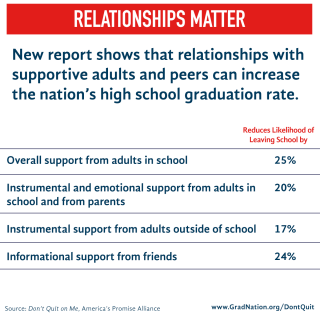
Young people told us that relationships buffer adversity and boost their chances of graduating on time — to a point. We found that:
  • Overall support from adults in school reduces the likelihood of young people leaving school by 25 percent. Instrumental support (e.g., shelter, food, clothing, transportation, tutoring) from adults outside of school reduces the likelihood of young people leaving school by 17 percent.
  • For young people experiencing medium levels of risk, high support from both parents and adults outside school makes uninterrupted enrollment 11 percentage points more likely than high support from parents alone. Adding a third source of support — friends — boosts likely continuous enrollment by another 5 percentage points.
  • But, for young people reporting five or more adverse life experiences, social support alone does little to increase on-time graduation. Uninterrupted graduation stays well below 50 percent even with high support from multiple sources.
Center for Promise
Source: Center for Promise
The trauma these young people experience each day inches them closer and closer to an adversity cliff, which many researchers have related to heightened levels of acute and chronic health conditions, drug use, risky sexual behaviors, and leaving school without graduating.
When considering the level of adversity these young people face, the inclination of practitioners and policymakers is to go myopic (No-excuse schools!), go too broad (Eradicate poverty!), or just throw up their hands in defeat (It’s too much!)
I understand. This level of adversity is too much for a parent, teacher, coach or mentor to resolve alone. But that’s no reason for us to quit. The young people facing the most adversity should get the most help. They need intentional, professionalized efforts to resolve trauma, health problems, and social and economic barriers.
Programs such as Communities in Schools(link is external)Turnaround for Children(link is external), and LIFT (link is external)help young people strip away the barriers that derail adolescents. They provide mental health services for trauma, housing vouchers for the homeless, and access to other much needed social services. With barriers resolved, young people have the bandwidth to focus on longer-term goals, including school.
Amanda stepped off the cliff, but there were people — teachers, mentors, friends — who grabbed her in time. With lots of the right kind of help, she survived.
With help, Amanda was able to direct her strengths toward the educational goals that can propel her toward her dreams. If that’s what we want for all young people, we can’t quit on those walking precariously close to the edge. 
Ret. 10-16-15

Monday, July 20, 2015

Essential or Dangerous Secrets

Quoting from The Secret Life of Families...

Dr. Imber-Black states that teens live in a very different landscape in which to make secrets than their parents or grandparents did.

Parents are often confused about how much privacy their teen can safely have and frightened about the meaning of secrets in their children’s lives..

The line between essential secrets and dangerous secrets has become exceedingly thin in an age when many teens keep such physically lethal or emotionally harmful secrets from their parents as severe alcohol and drug abuse, date rape, suicide attempts, and violent attacks by peers or strangers. 

Some parents have become afraid to ask their teens what’s going on in areas where it can be extremely dangerous to maintain silence. Distortion of the normal need for secrecy in adolescence, in a culture where the connections between teens and parents [or other authority figures] are often frayed, results in a pattern of mutual distancing and no conversation on topics that require greater openness.

Developing a thoughtful, creative position and a competent range of responses to teens and their secrets today involves a complex stew. A given family's current social and economic terrain, the values and beliefs embedded in ethnicity, social class, and specific history, and each parent's biography as a secret-keeping adolescent intertwine to inform actions.

Adolescent Secrets—Yesterday and Today

Take a moment to reflect on your own adolescence.
  • As an adolescent, were you able to keep secrets from your parents?
  • What were the secrets you kept?
  • How did your parents respond if they discovered one of your secrets?
  • Were there differences in the kinds of secrets that you kept from your mother and the ones kept from your father? What accounted for the difference?
  • What was the relationship like with your closest confidant?
  • Did you keep secrets from your siblings?
  • How would you compare the secrets you kept with the ones you imagine your teen keeps from you now?
  • How would you compare the secrets your parents kept from you with the ones you keep now from your teen?


Imber-Black, Ph.D., E. (1998). Private Investigations: Secrets Between Teens and Parents. In The Secret Life of Families (pp. 244-246). New York, NY: Bantam Books. 

Wednesday, May 27, 2015

Role of Relationship Quality

By  April 30, 2015

How mentoring affects academic outcomes: The role of relationship quality

airplaneBayer, A., Grossman, J. B., & DuBois, D. L. (2015). Using volunteer mentors to improve the academic outcomes of underserved students: the role of relationships. Journal of Community Psychology43(4), 408-429.
Summarized by Bridget Nestor
Introduction: School-based mentoring (SBM) refers to mentoring relationships in which mentors meet with mentees on school grounds, either during or immediately after the school day. For financially strapped school districts, SBM has the potential to provide a cost-effective way to assist and support struggling students. However, little research has been adequately conducted to understand the efficacy of SBM in improving academic outcomes, as well as the underlying mechanisms that could contribute to SBM’s effectiveness.
Rather, past research has focused mainly on community-based mentoring (CBM), or more traditional mentoring relationships that typically comprise of longer meetings between mentor and mentee and the participation in varied activities in different locations, not on school grounds. Additionally, the prior research that has been conducted on SBM has found mixed results with respect to the efficacy of SBM – some studies have found SBM to yield significantly improved outcomes for youth, while others have not. These conflicting findings are likely the result of studies with less rigorous research designs than the current study.
In the current study, Bayer, Grossman, and DuBois (2015) seek to address this gap in the literature by exploring whether SBM does yield significantly improved academic outcomes for youth, while also investigating the mediators of the effect of mentoring on youth outcomes. In doing so, the authors consider what makes for greater academic outcomes in SBM relationships – are feelings of closeness enough to produce successful academic outcomes, or do special focuses on academics within the SBM relationship lead to greater academic outcomes?
In addressing this question, the authors also strive to inform the debate between two competing perspectives in theoretical mentoring models – “mentoring-as-relationship” vs. “mentoring-as-context.” The former asserts that relationship closeness and quality are an integral precondition for positive youth outcomes in a mentoring relationship; many believe this notion to be particularly relevant for CBM, but the effects in SBM are unknown. In contrast, the “mentoring-as-context” perspective focuses more on how the mentoring relationship itself provides a space for improving skills and development while striving for specific goals, independent of the closeness within the relationship. Thus, this study measures relationship closeness and academic outcomes in SBM relationships to shed light on these points of discussion.
Method:
 Students who participated in the study were drawn from the randomized control trial of the Big Brother Big Sister Association (BBBSA) SBM program that was conducted during the 2004-2005 academic year. 1,139 students from 71 public schools in rural and urban school districts met criteria to be in the study. Half of the students were randomly assigned a mentor, while half were waitlisted to be matched with a mentor at the end of the study; there were no statistically significant differences between the two groups. 54% of the students were female and the average age of students was 11 years old. Mentors who participated in the study were also drawn from the BBBSA program. 72% of mentors were female and 48% were high school students.
Baseline surveys were administered to students, teachers, and mentors at the beginning of the school year, and follow-up surveys were also administered at the end of the school year. Measures of academic outcomes were assessed through both teacher and student ratings. Other explanatory variables were also assessed including mentee ratings of relationship closeness with their mentors, the length of the mentee/mentor match itself, and the status of the match. Match status refers to whether the original mentoring match was “intact,” the mentee had been “rematched” once a match ended, or the mentee had not been “rematched” once a match ended. 
Results:
  • Relationship closeness: only relationships which mentee rated as “somewhat close” or “very close” showed positive impacts on academic outcomes.
  • Match length: both long and close relationships as well as short and close relationships showed positive impacts on academic outcomes.
  • Match status: both intact matches and rematched students in close relationships showed positive impacts on academic outcomes. However, rematched mentees who did not feel close to their new mentors did not show positive academic outcomes.
Implications:
 Above all, the findings of this study highlight the importance of relationship closeness within mentee/mentor relationships in the context of SBM. Particularly, if mentees did not find their relationship to be at least “somewhat close,” then there were no significant differences in their academic outcomes as compared to the academic outcomes of students who were not matched with mentors. Moreover, relationships closeness trumped both match status and match length as predictors of academic outcomes. Specifically, so long as relationships were deemed at least “somewhat close,” then neither the length of the match, nor the status of the match (either original match or rematch), significantly affected academic outcomes for mentees. These findings suggest that relationship closeness may be the most integral component of relationship closeness.
The current study also sheds light on the debate between the “mentoring-as-relationship” perspective vs. the “mentoring-as-context” perspective. This study found more merit in the “mentoring-as-relationship” perspective as it was relationships closeness, not a focus on academics, which led to greater academic outcomes in mentees. Future research should thus focus on how to maximize relationship closeness and how to better understand the underlying mechanisms that facilitate this closeness.
Ultimately, this study’s findings have exciting implications for schools that are looking for cost-effective ways to support struggling students. Simply by cultivating emotionally close relationships with mentees, mentors may be able to improve students’ academic outcomes. This means that volunteers need not be trained with a rigorous academic background, and that mentors might prove as beneficial as tutors to struggling students. Finally, by underscoring the efficacy of SBM, this study emphasizes the multifaceted and ever expanding effects that mentoring can have on young people.
Ret. 5-20-15

Friday, May 8, 2015

Mentoring and Perennials Analogy, Rhodes

Another must read from the Chronicle of Evidence-Based Practices...
By  May 7, 2015 

On Mentoring and Perennials

Screen Shot 2013-06-28 at 9.41.36 AMBy Jean Rhodes and Belle Liang.
Spring is in the air in Boston and the flowers are finally beginning to bloom, so it seems like as good a time as any to share with you a commentary on mentoring that draws inspiration from gardening. It’s an updated version of a column that was written with my friend and colleague Professor Belle Liang, and a version appeared in Applied Development Science. As we note, since the goal of mentoring is the establishment of an enduring relationship with lasting benefits, a mentoring relationship is more like a perennial than an annual. With this in mind, we draw on the wisdom of perennial gardeners to set forth six principles of mentoring – akin to preparing the soil, seeding, weeding, feeding, persevering, and evaluating for the next growing cycle as set forth in Strauss’ (2006) The Gardening Analogy.
Lesson One: Prepare the soil – “As with most gardening projects, planning and preparation is best begun well ahead of planting time” (Strauss, 2006, p. 1).
In mentoring, preparing the soil involves pre-match preparation and training for volunteers, as well as for youth. Pre-match preparation may start with early identification of individuals who are not a good fit for mentoring work. That is, close, effective mentoring relationships seem to be facilitated when adults possess skills and attributes including: prior experience in helping roles or occupations, an ability to demonstrate appreciation of salient socioeconomic and cultural influences in the youth’s life (Hirsch, 2005), and a sense of efficacy in mentoring young people.
Besides pre-screening and selection, programs can also act proactively by setting appropriate expectations for the mentoring role, processes, and outcomes. For example, many mentors expect that an immediate bond will develop with their mentees and that the balance of the experiences will be more “fun” than work, or they assume their mentee will be grateful for the many sacrifices that the volunteer has made on his or her behalf. Such expectations can lead mentors to feel disappointed, unappreciated, and even exploited, especially early in the relationship. Young people are often brought into a mentor program because they have had unsatisfactory relationships in the past, and they may not know how to engage in a mutually satisfying friendship. Alternatively, adequately conveying to volunteers what they can expect from their mentee, the relationship, and the roles of each partner, as well as the difficulties that they might encounter can prevent some of these disappointments. Some practitioners have argued that such “full disclosure” might amount to scaring away potential volunteer recruits and, indeed it would be a mistake to delve into every possible way that a relationship can go awry. Yet, the pendulum has swung too far in the other direction, where, in an effort to recruit more volunteers, many programs overemphasize the enjoyable, social aspects of the endeavor. Despite these messages and expectations emphasizing the “fun” aspects of mentoring, the fact is, volunteers who work on youth development issues have reported other motivations for their involvement, especially the desire to increase their understanding of themselves, others, and the world around them. Ultimately, when the actual experience of mentoring aligns with their motivations or expectations, volunteers are less likely to drop out prematurely.
Lesson Two: Seed – “Plant the seeds and seedlings in the soils that match variations in their conditions” (Strauss, 2006, p. 1).
Finding the right fit between volunteers and youths is critical to the longevity and outcomes of the match. Mentors and youth come with different backgrounds, personalities, expectations, and skill levels; matching and training should take these differences into account. Mentees typically represent diverse demographics, including boys and girls who differ by racial and ethnic minority background, socioeconomic status, disability, and religion. Although the research does not necessarily indicate that mentors must be matched on these dimensions, studies do show the importance of a basic compatibility between the youth and mentor in their personalities, interests, and expectations or goals for the relationship.  In addition, close emotional connections between youth and mentors appear to be fostered by factors resembling those identified as important in effective therapeutic relationships – mutual empathy and authenticity as well as basic compatibility and enjoying each other’s company.
Lesson Three: Weed – “Remove weeds and other competitive threats (Strauss, 2006, p. 1).
Not everything that sprouts in a garden belongs there and, likewise, mentors and their case workers need to be on the lookout for insidious problems that may arise at any point in the match. Vigilance against such negative influences requires reasonable ratios between case workers and mentors,,so that case workers are not overwhelmed by the number of cases and are thus able to provide adequate supervision to mentors. Mentoring relationships, like other types of relationships, are constantly at risk for misunderstanding, conflict, and various types of communication breakdowns, particularly in the early, vulnerable stages of the relationship. As Shakespeare observed, “Sweet flowers are slow and weeks make haste.” If not handled well, relationship problems can compromise the bond before it has had a chance to take hold. Whatever the source of dissatisfaction or unmet expectation, communication is always critical.
Lesson Four: Feed – “Amend the soil and keep plants cared for — pruned, fed, and strong — so that threats can’t harm them” (Strauss, 2006, p. 1).
In many mentoring programs, training efforts are uneven and fall largely in the realm of passive approaches (e.g., information packets to mentors) rather than active technical assistance. Furthermore, many programs spend minimal time with case management, which often takes the form of monthly perfunctory phone calls or emails. Taken together, these approaches have reduced the burden that is placed on the agency and volunteer in order to facilitate shifts in priorities toward volunteer recruitment, intake, and matching. Yet, research indicates that comprehensive orientation, supervision, consultation, and volunteer staff development, are all critical to promoting growth.
In addition to relationship-building skills, mentors must be trained regarding ethnic and cultural issues as well as developmental issues, and how these intersect with power dynamics that are particularly relevant in mentoring youth. For example, because most youth entering mentoring relationships are still minors and live at home where struggles for autonomy and control prevail, mentors need to attend to the subtle dynamics of the parent-child dyad. Furthermore, because youth are simultaneously undergoing multiple developmental changes in biological, psychological, and social realms, their mentors must have a solid grasp of developmental issues and cultural issues that may shape the needs, values, and perspectives of youth. In addition to these important areas of training and growth, volunteers and youth need adequate contact with supportive individuals who provide encouragement and feedback conducive to establishing strong roots for mentoring relationships.
Lesson Five: Persevere – “Don’t give up on a dead plant” (Strauss, 2006, p. 1)
Mentors need to be encouraged to persevere in maintaining the relationship given that most youth mentor relationships take time to evolve and their benefits accrue over time. Even seemingly disinterested protégés or unfruitful relationships may spring up or begin new growth unexpectedly. Thus, mentors should be made aware of research documenting the relatively slow pace of a youth mentor relationship as its most natural course, so that they come to expect a period of early dormancy similar to that described by Edward Payson Roe: “Look at us, said the violets blooming at her feet, all last winter we slept in the seeming death but at the right time God awakened us, and here we are to comfort you” (1876).
Lesson Six: Evaluate – “Watch the garden to see soil changes, to know what plants will continue to flourish and to know what new plants to introduce” (Strauss, 2006, p. 1).
Because it is generally assumed that mentoring benefits young people, programs may be hesitant to spend precious resources on expensive program evaluations. Choosing not to evaluate, however, is shortsighted. Effective program evaluation can provide vital information about a program; this enables informed decisions regarding what is working as well as where resources and efforts might be re-directed. Indeed, not all mentoring programs, or interventions within mentoring programs, are equally beneficial and much is still to be learned about the newer types of mentoring programs (e.g., site-based, group, peer, internet). Moreover, much is to be learned about which aspects of mentoring programs are beneficial and transformative and which are less so.
Final Thoughts
To be effective, mentors need to tolerate all kinds of uncertainties, to address ethical dilemmas and disappointments as they arise, and to know whom to turn to for consultation and how to work through uncharted territories. Yet, naturalist Frederick Frye Rockwell (1917) provided a useful caveat regarding the limitations of such principles:
“The gardener who imagines that his work can be reduced to a set of rules and formulae, followed and applied according to special days marked on the calendar, is but preparing himself for a double disappointment.”
Likewise, although the mentoring guidelines presented here and elsewhere are useful, an individual approach to each youth should be crafted. Guidelines can only touch the surface of the intricacies involved in mentoring someone. They are likely to be most effective when they are used as a framework that leaves room for volunteers’ to apply their intuitive wisdom and allow the relationship to grow and thrive in all of its complexity.
http://chronicle.umbmentoring.org/on-mentoring-and-perennial/
Ret. 5-8-15


Monday, March 30, 2015

Good Mentoring Relationship


Thanks to Kansas Mentors' Facebook on February 17, 2015 for this post.

https://www.facebook.com/permalink.php?story_fbid=10153112729483184&id=41922213183


Rajesh Setty Headshot


9 Characteristics of a Good Mentoring Relationship


Posted: Updated: 

2015-02-13-mentoringcontribution.jpg

A good mentor is a gift from the Universe. If you find one, do everything you can to convince them that it is worth their while to mentor you. I am fortunate to be on both sides of the table almost on a weekly basis -- meaning I have awesome mentors that inspire me and hold me accountable and I also happen to have awesome mentees who are enthusiastic about learning and are like my extended family.
Here are 9 characteristics (in no particular order) of a good mentor:
1. Conversations
In general, the basic mode of mentoring is having meaningful conversations that will move the needle in areas of your life or business that matter most to you. A conversation that moves the needle is "effectuation in action." It is one that makes the most of your strengths, factoring in your current constraints and creates a set of possibilities that will show you how to make meaningful progress in a reasonable amount of time.
2. Commitment
A good mentor goes beyond to change his or her agenda and strive to make you a better YOU. Such a mentor is committed to your growth journey through the ups and downs you experience, and entering and navigating you out of your "comfort zone" to make something extraordinary happen.
You can measure the commitment of a mentor by the tough questions they ask, with the intent to get you to see things that you are not otherwise seeing, and get you 'unstuck.' If a Mentor is always saying great things and making you feel really good all the time, perhaps he or she is being a 'cheering friend,' but not a 'caring mentor.'
3. Curiosity
As they say, "if you are doing what you have been doing, you will continue to get the results you have got." There are exceptions to this rule, but that's outside the scope of what we are discussing here.
There is a reason why you continue to do what you are doing even when it may not be producing the results you are expecting in your life or business. These less-than-effective activities may have become 'dragging' habits. Whatever the reasons may be, it is not too late to change course.
As Charles Duhigg says in his landmark book, "The Power of Habit," the three elements of creating a habit are cue, routine and reward. A cue triggers an almost automatic routine that is producing a reward as a result of you engaging in the activity.
So, to a start a new and better habit, you need to start with a different cue - something that you may not be aware of. A pre-cursor to that is for you to generate the curiosity to look at the same things that you are exposed to today with a different set of eyes.
A good mentor opens up the doors to curiosity so that you get back that childlike enthusiasm to learn and grow.
4. Clarity
Clarity is the side-effect of a good mentoring relationship. Think about it - you are very close to your life/business so it is hard for you to get a "helicopter view" of the same. In a good mentoring relationship, this comes automatically as your mentor is someone who cares about your life and business and by default has a "helicopter view" of both of them. The conversations automatically help you discover the "forest for the trees" - thus bringing clarity to your goals and actions.
5. Capacity
Power from a philosophical perspective is the "capacity to take action to produce meaningful results." You increase your capacity and you can produce better and bigger results in the same amount of time. Sometimes it's a small shift in the way you are thinking that will put your capacity into high gear. Your mentor can unlock that untapped capacity which you can put to work to accelerate your success rate.
A good way to know this is if at the end of a conversation with your mentor, you begin to find some things that seemed "impossible" seem totally "possible."
6. Confidence
Confidence will empower you and will give you the motivation to take the right actions. Sometimes what might be preventing you from taking those right actions (even when you know you should) are the limiting beliefs you have about yourself and the lack of confidence in pulling something off. A good mentor may not give you strength, but helps you discover your hidden strengths and help you move beyond your limiting beliefs. "A good mentor believes in you lot more than you believe in yourself, and becomes your champion," says Dr. Ravi Gundlapalli, a global thought-leader in mentoring and CEO of MentorCloud.
7. Connections
The right connections for you at the right time can instantly open new doors, expand your capacity and give you credibility by association. A good mentor thoughtfully connects you to the right people via his or her network. It is important that you grow and earn that right to deserve such introductions.
8. Choreography
Navigating out of your comfort zone is never easy and fun. Logically, there is discomfort on that path that generally creates resistance tempting you to go back to the "tried and tested" approaches. A good mentor can not only help you choose among the available options at hand, he or she can teach you how to choreograph the sequence of steps so that you get maximum leverage.
9. Celebration
In a good mentoring relationship, a mentor and mentee celebrate their relationship, the mini, micro and macro victories that they co-create together as they build a relationship that steers your life journey in a compelling way.
Last, but not the least, good mentoring relationship is a two-way street and both of you are co-creating your future. Mentor benefits too by being there and watching you grow in your journey. "Teach someone if you want to know how much you have learned. Mentor someone if you want to know how valuable you are to those around you." Good Mentors are those that enjoy being of immense value to others and seeing good things happen to those they care about.
Related Reading: