Wednesday, July 20, 2016

STEAM Academy Outing 2015 II: Biology & OK Symbols

Two other portions of the OKAN's Eugene Field Elementary's STEAM academy nature outing curriculum featured biology and Oklahoma symbols. 

Recap of presenters from previous post

Presenters for the "Martin Nature Park Outing" were William "Bill" Diffin, president of the Central Oklahoma Audubon Society; Linda Daxon, Central Oklahoma Beekeepers Association and an OKC realtor;  Paul Olson, Ph.D., plant biologist from the University of Central Oklahoma; his son and assistant Luke; Kim Shaw, Blue Thumb education coordinator, Oklahoma Conservation Department; Kim's intern Ariel McAffrey; Karla Beatty, education coordinator, carbon/soil health program, Oklahoma Conservation Department; and Denise Ebersbach, Edmond community volunteer. Diffin and Daxon were mentioned in the previous post about the birds and bees.


Plant Biology


"Dr. Paul" in true Aristotelian fashion used the peripatetic teaching method. As a plant biologist, subject matter was everywhere--up, down, and all around.  As he was about to begin with one of the rotating groups of students, Luke, his son strikes a pose. 


Dr. Paul remarked later that he would have been successful if he taught them to "Just look up!" So much wonder surrounds us, and we simply don't look or take notice. 

Note the young man on the left is looking up in a manner similar to his instructor's.


Listening to questions


That Dr. Paul Olson, a faculty member of the University of Central Oklahoma, took his time to teach and interact with these students has many effects. Although he volunteered because he is a considerate man and an advocate both of biology and educating younger students, he inadvertently performed higher education outreach. All of the volunteers represented and presented their passions well. Who can conjecture what positive ramifications this outing day may have? 


And off they go!
Oklahoma Symbols

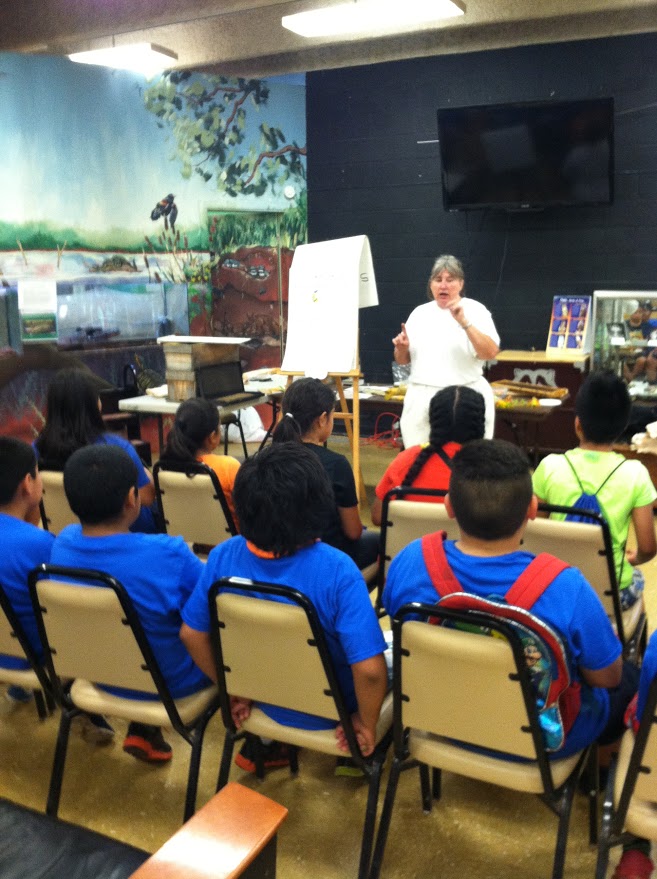
Denise Ebersbach, an Edmond community volunteer, studied the Oklahoma symbols lesson and artifacts from the traveling trunk checked out of the Oklahoma History Museum. If you haven't looked at and used any of the resources available through the center, you should. 

For more information on the Oklahoma Symbols trunk:
http://www.okhistory.org/kids/symbols? 

Some touchables included a stuffed bison plush toy, which Ebersbach is holding in the photo; watermelon; a miniature cotton bale wrapped in burlap; rose rock; a twister in a bottle; and much more.

For example, do you know what Oklahoma's meal is?
"Fried Okra, Squash, Cornbread, Barbeque Pork, Biscuits, Sausage & Gravy, Grits, Corn, Strawberries, Chicken Fried Steak, Black-eyed Peas, and Pecan Pie"

Oklahoma's flying mammal is the Mexican Free-tailed Bat, milk is the state drink, and the honeybee is the state insect, watermelon is the state vegetable, and the state musical instrument is a fiddle. Among many other Oklahoma symbols, we have state songs. Did you know that "Faded Love" by John Willis and Bob Wills is Oklahoma's country and western song, and its rock song is "Do You Realize??" by the Flaming Lips? Check out the trunk(s)!

The outing culminated the two-week learning experience. 

OKAN, the Oklahoma Expanded Learning Network, organized the Eugene Field Summer STEAM Academy through a partnership with the City of Oklahoma City and Oklahoma City Public Schools.

Here is the group photo, also published in the first post. These were well-behaved, curious, kind, appreciative students. Bravo to Eugene Field Elementary parents and teachers for a job well done.


Tuesday, July 19, 2016

STEAM Academy Outing 2015 I: Birds & Bees

Through Community Development Block Grants administered through the City of Oklahoma City and in partnership with Oklahoma City Public Schools, OKAN, the Oklahoma Expanded Learning Network, organized two STEAM academies.

The STEAM summer academy for Eugene Field Elementary School students ended with an outing to Martin Nature Park and hands-on instruction and activities led by experts.


Presenters for the "Martin Nature Park Outing" were William "Bill" Diffin, president of the Central Oklahoma Audubon Society; Linda Daxon, Central Oklahoma Beekeepers Association and an OKC realtor;  Paul Olson, Ph.D., plant biologist from the University of Central Oklahoma; his son and assistant Luke; Kim Shaw, Blue Thumb education coordinator, Oklahoma Conservation Department; Kim's intern Ariel McAffrey; Karla Beatty, education coordinator, carbon/soil health program, Oklahoma Conservation Department; and Denise Ebersbach, Edmond community volunteer.


These Eugene Field students knew their Oklahoma birds and eagerly raised their hands to answer Diffin's inquiries.


Diffin really made birding fun. Following a review of bird types the students would likely see and an adjustment of binoculars, the group went outdoors to "bird."


Diffin even offered his own more expensive binoculars to one of the students who had a malfunctioning binoculars.

Martin Nature Park has many trails to explore, and Diffin as well as Dr. Olson had made previous trips to the park just to reconnoiter.


He even brought bags of cat food so the fifth graders could feed the turtles and catfish. Yes, there some some catfood-gorged turtles and catfish that day.

Bees

Another portion of the nature outing curriculum featured bees. Linda Daxon, beekeeper or apiarist, gave each rotating group a riveting lesson about bees. When Denise Ebersbach asked students fresh from Daxon's presentation what they liked and learned, without hesitation they recounted much of what Daxon presented.
The Buzzzzz About Honey Bees


Daxon's wearing her bee suit and helmet with veil was exciting. With much thought and creativity, she created her own flip-chart presentation.


Normally she did not wear special shoes because bees instinctively attack enemies' eyes, hence beekeepers' wearing helmets.


As the photo shows, Daxon brought many items related to beekeeping and honey. On the right of the photo is a hive box. She also pulled a hive frame and allowed each student to taste both the fresh honey comb and pure honey. 


In addition, she picked fresh flowers to show pollen which bees collect and spread, stressed that bees are essential in pollinating crops, explained colony collapse, and gave scientific data about insecticides effect on bees, their honey, and their honeycomb--thus on us humans.

Daxon does collect some of her bees' honey and other some products that the hive produces such as beeswax, propolis, pollen, and royal jelly.  

From one of her posters:

"Did you know there are 

-  about 25,000 types of bees in the world

- about 4,000 types live in the U.S."


From another poster:

"Today we are going to talk about honey bees.

The honey bee is the only insect that makes something humans eat...honey!

The average American eats about 1.31 pounds of honey a year.

How many bees visiting how many flowers does it take to make a pound of honey?"

Although Daxon did not mention this site, The Canadian Honey Council says the answer is "two million flowers and fly 50,000 miles (80,000 km) to make one pound (454 g) of honey." 

Also "A single honey bee makes about 1 and ½ teaspoons of honey during its lifetime." 

http://www.honeycouncil.ca/chc_poundofhoney.php 

This information certainly increases the value of honey and appreciation of a bee, doesn't it?


The group photo--Eugene Field STEAM academy students, teachers, chaperones, and presenters.


The Boren Mentoring Initiative's Bev Woodrome cold-called the passionate experts to volunteer their time and expertise. Cedric Currin-Moore, OKAN's STEM director, coordinated the logistics of the day with Oklahoma City Public Schools. School bus transportation and schedule, sun screen, bug spray, drinks, and sack lunches are part of the preparations. The students left the school, arrived by bus about 9:15 a.m. and departed at 2:00 p.m. 

This is a model that can be adapted on a different scale for local communities or a specific school or class. Look around at the experts--professional and amateur--in your community.

Monday, July 18, 2016

Communicating with "I"

This author shares more helpful free information on anger management, damning and blaming, etc. Explore and use what you can and/or add to mentor training.
Communicate with “I” Statements
Say What You Thought, Not What They Did
by Kevin Everett FitzMaurice, M.S., NCC, CCMHC, LPC


“First, don’t interpret or add to what they said–just hear it and share it back.”–Kevin Everett FitzMaurice

INTRODUCTION
“I” statements put the focus and responsibility on the communicator. Thus, they are a lot less likely to be resented.
Unlike “You” statements, which put the receiver of the communication on the defensive, “I” statements are a way to convey your message without immediately alienating your listener.
“I” statements do not guarantee success, but they are your best chance of getting your message heard.
If the person is open to considering your needs and wants, they will be much more likely to do so if you use “I” messages than if you use “You” or blaming messages. Simply, they increase your odds of being heard. Make statements, not accusations!

BASIC FORMAT
I feel . . . when . . . because . . . .
Extension 1
I feel . . . when you (do or don’t) . . . because I think . . . .
Extension 2
I felt . . . when . . . because I thought it meant . . . .
Extension 3
I feel . . . when . . . happens because I interpret it to mean that I am . . . .
Extension 4
I felt … when you did … because I took it to mean that you thought I was ….

FIRST PART
“I feel . . .”
The first part is used to state what it is that you feel about what happened, or what it was that you felt about what happened. You need only use one or two feeling words for the first part.
For example, write in “hurt, sad, afraid, mad, glad, happy, lonely, discounted, unloved, anxious, guilty, excited, ashamed, or shocked.” In Rational Emotive Behavior Therapy (REBT) shorthand this is the C part.

SECOND PART
“when . . .”
The second part is used to let the other person know what the event was that you are referring to. It is the ‘what happened’ part of the “I” statement.
The second part can contain a ‘you’, and it is the only one of the three parts that you should allow to contain a ‘you’ when you are expressing hurt or angry feelings.
If you are expressing happy or excited feelings, then you can use a ‘you’ in both the second and third parts if you want to. For example, write in “when you yelled at me, when you were late, when you forgot my birthday, etc.” In REBT shorthand this is the A part.

THIRD PART
“because . . .”
The third part is used to explain what you thought about the event, about what happened. This is where you let the other person know how you interpreted the situation.
Answer this question for the third part: “What did the event mean to you?” For example, write in “I thought you didn’t like, respect, trust, care, etc., about me.” In REBT shorthand this is the B part.

RATIONAL EMOTIVE BEHAVIOR THERAPY (REBT)
Now that we know the three parts of an “I” statement, we can understand the whole expression using the paradigm, the model of REBT. According to REBT, we have most of our feelings about events, experiences, and occurrences only after we think about ourselves in relation to them.
When we use “I” statements, we are communicating in a different order from that which produced our feelings. Our feelings are last, C, but we are putting them first to disarm our listener and to defuse the communication process.
The actual order of events would be “when because feel” or A » B » C. However, we express them as “feel when because” so that our feelings are regarded as the primary message, as the part that we want to be considered most important.
EXAMPLE
“I felt embarrassed and ashamed when you found typing errors in this handout, because I thought it meant that I was a fool and inadequate.”

ADDITIONAL HELP
If the person makes the mistake of challenging your reality (see the page Don’t Argue Reality), you can then inform them that you said “I think it means” and not “it is.” The point being that you are not blaming or damning them for your feelings. Instead, you are taking responsibility for your feelings based on your thinking.
You can then say that your intent was to help them to understand how you think and feel. You can then add that it would be nice if they took how you felt and thought into consideration, but that it was not required. Additionally, you can tell them that they are free to keep their own view, perspective, or interpretation of the topic just as it was before you shared yours if they so desire.

LONG FORMAT
Here is another format that you may prefer or find useful in some situations. In this system, you use four “I” messages in rapid succession.
The correct order is: I sense …. I think …. I feel …. I want ….. The first “I” message is about what you sense, for example, what you see or hear. The second “I” message is about what you think or how you judge. The third “I” message is about what you feel. And the fourth “I” message is about what you want or desire.

BASIC LONG FORMAT
I sense . . . . I think . . . . I feel . . . . I want . . . .
Extension 1
I see you (doing) . . . . I think (what you see them doing) means . . . . I feel . . . (about what it means to or for me). I want you to (do) . . . instead.
Extension 2
I heard you say . . . . I took it to mean that . . . . I felt . . . about it (in that light or with that understanding). I would prefer it if you would . . . .
Extension 3
I was told you (did) . . . . I interpreted it to mean . . . . I then felt . . . . I wish you would . . . .
Extension 4
I smelled . . . . I believed it meant . . . . I felt . . . after thinking that about it. I would like it very much if you would . . . .

FIRST MESSAGE
“I sensed . . . .”
The first message is used to state what it is that you are experiencing. You are relating to the other person as accurate a description of your physical experience as you can. You tell them just what you see, hear, taste, smell, and touch.
You do not interpret or add to it. You do your best just to report objectively what you have observed. It is the ‘what happened’ “I” statement. For example, “I saw you talking to an attractive woman.” In REBT shorthand this is the A.

SECOND MESSAGE
“I thought . . . .”
The second message is used to let the other person know what you interpreted the event to mean. The purpose here is to tell them how you understood what you sensed. This is the ‘meaning’ “I” statement. This is where you admit to the other person how you interpreted the situation.
Convey here the meaning the event had for you and nothing else. Neither justify it nor disparage it. For example, write in “I thought you didn’t like, respect, trust, care, etc., about me.” In this example, you might say “I thought you were flirting with her.” In REBT shorthand this is the B.

THIRD MESSAGE
“I felt . . . .”
The third message conveys your feelings about what you thought about what you sensed. Be careful not to add to your feelings or to try to rationalize them here. Keep it simple. Keep it to the point.
For example, write in “hurt, sad, afraid, mad, glad, happy, lonely, discounted, unloved, anxious, guilty, excited, ashamed, or shocked.” In this example you might say, “I am feeling jealous of your attentions to her.” In REBT shorthand this is the C.

FOURTH MESSAGE
“I want . . . .”
The fourth message is used to express what you want the other person to do differently for you. This message is used to make requests, to seek changes from the other person. For example, “I would prefer it if you would not spend so much time with attractive and available women when we go to parties.”

GOAL FOR “I” MESSAGES
You may still not get what you want. But at least you shared your experiences, gave the other person your reasons, and shared your feelings with them.
If they chose to respond, all well and good. But if they did not. You still managed to express your true self. Being able to say what you think and feel–without blaming others for it–is a true measure of mental health.

Additional and Related Information
Styles of communicating: 25 Relational Styles
Rational Emotive Behavior Therapy (REBT): REBT’s ABCs of Emotions
Advanced “I” Messages: “I” Statements–Advanced

from website
QUOTATIONS VARIOUS SOURCES
“Two monologues do not make a dialogue.”–Jeff Daly
“Most conversations are simply monologues delivered in the presence of a witness.”–Margaret Millar
“Be who you are and say what you feel, because those who mind don’t matter and those who matter don’t mind.”–Dr. Seuss
“There are very few people who don’t become more interesting when they stop talking.”–Mary Lowry
“Some man holdeth his tongue, because he hath not to answer: and some keepeth silence, knowing his time.”–Ecclesiasticus 20:6
“Treat a man as he is, and he will remain as he is. Treat a man as he could be, and he will become what he should be.”–Ralph Waldo Emerson
“The most precious things in speech are pauses.”–Ralph Richardson
“Don’t speak unless you can improve on the silence.”–Spanish proverb
“Foolishness always results when the tongue outraces the brain.”–Unknown
“Among my most prized possessions are words that I have never spoken.”–Orson Card
“Pleasant words are as an honeycomb, sweet to the soul, and health to the bones.”–Proverbs 16:24
“Draw me not away with the wicked, and with the workers of iniquity, which speak peace to their neighbours, but mischief is in their hearts.”–Psalms 28:3
“But as he which hath called you is holy, so be ye holy in all manner of conversation;”–I Peter 1:15
“The first duty of love is to listen.”–Paul Tillich, 1886-1965


Ret. 7-18-16


Tuesday, July 12, 2016

Local Coaches' Support of Mentoring

Leedey Public Schools' BISON coaches support mentoring,
Team Oklahoma, and the Coaches' Mentoring Challenge.
Head Baseball Coach Eric Castle, Elementary Basketball
Coach Kris Gore, Head Girls' Basketball Coach Leah Beer,
and Head Boys' Basketball Coach Lance Carpenter
all are B.I.S.O.N. Mentors, too. 11-10-15
Below are ideas borrowed from Team Oklahoma in the Coaches' Mentoring Challenge. OSU's Coach Mike Gundy and OU's Coach Bob Stoops will co-captain Team Oklahoma in this multi-state new mentor recruiting campaign. Kansas State University's Coach Bill Snyder and University of Nebraska's Coach Tom Osborne began the challenge in 2008.

Why Coaches?
  • Coaches are natural group mentors. 
  • Their upperclassmen peer mentor younger teammates.
  • Fans respect and follow coaches so their voices matter.
Coaching and mentoring are synonymous, and we salute all coaches who have shaped and are shaping young men and women into citizens of character, action, and discipline.

Coaches cannot mentor every youth in their towns, but they can use their considerable influence to advocate for mentoring, recruit new mentors, and/or spur a pilot mentoring program where none exists.

Requirement for Endorsing the Challenge/Mentoring

The only requirement for signing up for the challenge is that the Boren Mentoring Initiative is allowed to use coaches' photos and endorsement in PR and social media to advocate mentoring and recruiting new mentors.


Rogers State University Coaches with
mentors and mentees, July 2016
Above is another example of a group photo coaches at RSU in Claremore took to endorse mentoring. Pictured are Director of Athletics Ryan Erwin, Golf Coach Josh Fosdick, Cross Country/Track and Field Coach Chris McCormick, Baseball Coach Chris Klimas, Men’s Basketball Coach Justin Barkley, and Men’s Soccer Derek Larkin.

Optional Ways to Support the Coaches’ Mentoring Challenge (and mentoring all through the year)

Anywhere on Campus or at a Staff Meeting
Pose with signs supporting mentoring and send us the photo. (See above.)

At a Game
  • Allow mentoring programs to host a mentor recruitment table at a home game. 
  • Allow a mentoring public service announcement to be read over the loudspeaker during one or more home games. Or prerecord your own public service announcement.
  • Provide a limited number of free game tickets for mentors/mentees to attend a game and/or a receive a free concession item.
  • Give mentors/mentees a moment for on-field recognition.
  • As a group, allow mentors/mentees to meet you and your players for autographs
  • Spotlight any of your team or fellow coaches who mentor.
Within Your Community
  • Encourage athletes, parents, fellow coaches and fans to become mentors.
  • Issue a local press release in partnership with community mentoring programs.
  • Print and display Coaches’ Mentoring Challenge or mentoring posters in the school or on campus or have students design their own.
  • Share your own mentoring stories with local civic and religious groups to recruit mentors.
On Social Media
  • Post photos and updates about your involvement in mentoring or the Coaches’ Mentoring Challenge to Facebook, Twitter, YouTube or other social media outlets. Please include the hashtag #okcoacheschallenge at the end of your post.
  • Send photos with captions and news of your efforts to bwoodrome@ofe.org. Please note that students under 18 must have parent/guardian permission to publish photos in print and online.
Advocate or endorse the development of a local mentoring program, such as:
  • A peer mentoring program on your campus for upperclassmen mentoring freshmen.
  • A program for college or high school students to mentor elementary and middle school students.
  • Career-oriented mentoring program by community professionals for high school and college students.
  • After practice one evening a week, have a team mentoring program, such as Camp Fire Club or some other mentoring model that teaches life skills, community service, and outdoor activities. Your team could also serve as peer mentors to younger students.
[On 7-12-16, we visited with Sara Williams, Rogers State University's Assistant AD, and we can hardly wait to post the creative ways RSU athletes mentor and/or interact with community youth. Stay tuned!]
http://okcoacheschallenge.org/
Ret. 7-11-16

Teacher Mentor and Community Mentor Model

2015 Bob S. Gee Scholars and their mentors gather for meeting at the Miami Public Schools Administration offices. The program, which provides mentoring and financial support to students, is sponsored by the Miami Public Schools Enrichment Foundation.
Miami Public Schools Enrichment Foundation has created a two-mentor plus model. 

Highlights of Gee Scholars

  • Teacher mentor
  • Community mentor
  • Mentee: FRSL, 8th - 12th grade
  • Mentee's progress tracked
  • Financial assistance


Robert S. Gee Scholarship Program


The Robert S. Gee Scholarship Program, sponsored by the Miami Public Schools Enrichment Foundation, was established in 2005 to provide both financial and mentoring support to help launch students toward personal and academic success.
 
"The program seeks out students in eighth through 12th grades who have shown a high degree of academic ability but whose socio-economic situation presents barriers to reaching their full potential," said longtime program chairman Ginny Stinson.
 
To participate, students must be nominated by a teacher and be eligible for the federal free and reduced lunch program. Students selected for the program receive intensive mentoring from both a teacher mentor and community mentor, who is often a foundation board member. The student and his or her mentors establish their own mentoring schedules, and the chairperson of the Gee Scholarship Committee meets with each student on a regular basis to track his or her progress.
 
Scholars also receive financial assistance to pursue academic and extracurricular activities. Once selected, the students remain in the program throughout high school. The program is funded from community donations and interest income from the Gee Scholarship Fund, providing approximately $500 to $700 per year to each student for school-related expenses, which must be approved by the scholarship committee.
 
"Appropriate requests for financial assistance include almost anything that assists the student in pursing academic or extracurricular endeavors, such as band, debate, science fair, etc.," Stinson said. "Senior Gee Scholars often use their funds for college applications, graduation supplies or college enrollment fees."
 
Since the program began, it has distributed more than $25,000 to 30 Gee Scholars. Stinson said the program's success can be measured by the strong community support and the many Gee Scholars who have been admitted to college, including two who received full-ride college scholarships.
 
"Gee Scholars themselves help raise funds and general community support for the program by sharing their stories and plans for the future at the foundation's annual fundraising dinner, the Blue Event," Stinson said.


Oklahoma Foundation for Excellence. (2016) Three Public School Foundation ProgramsTo Be Recognized for Outstanding Achievement [Press release]. 


Saturday, July 9, 2016

How to Deal with Stress II


Fight Stress with Healthy Habits  Updated:Nov 11,2015

Healthy habits can protect you from the harmful effects of stress. Here are 10 positive healthy habits you may want to develop.
  1. Talk with family and friends.

    A daily dose of friendship is great medicine. Call or writer friends and family to share your feelings, hopes and joys and ask them to share theirs.
  2. Engage in daily physical activity.

    Regular physical activity can relieve mental and physical tension. Physically active adults have lower risk of depression and loss of mental functioning. Physical activity can be a great source of pleasure, too. Try walking, swimming, biking or dancing every day.
  3. Embrace the things you are able to change.

    While we may not be able to do some of the things we once enjoyed, we are never too old to learn a new skill, work toward a goal, or love and help others.
  4. Remember to laugh.

    Laughter makes us feel good. Don't be afraid to laugh out loud at a joke, a funny movie or a comic strip, even when we're alone.
  5. Give up the bad habits.

    Too much alcohol, cigarettes or caffeine can increase blood pressure. If you smoke, decide to quit now. If you do drink alcohol, do so in moderation.
  6. Slow down.

    Try to "pace" instead of "race." Plan ahead and allow enough time to get the most important things done without having to rush.
  7. Get enough sleep.

    Try to get six to eight hours of sleep each night. If you can't sleep, take steps to help reduce stress and depression. Physical activity also may improve the quality of sleep and life in general.
  8. Get organized.

    Use "to do" lists to help you focus on your most important tasks. Approach big tasks one step at a time. For example, start by organizing just one part of your life — your car, desk, kitchen, closet, cupboard or drawer.
  9. Practice giving back.

    Volunteer your time or spend time helping out a friend. Helping others helps you.
  10. Try not to worry.

    The world won't end if your grass isn't mowed or your kitchen isn't cleaned. You may need to do these things, but right now might not be the right time.
Learn more:

Last reviewed 6/2014

http://www.heart.org/HEARTORG/HealthyLiving/StressManagement/FightStressWithHealthyHabits/Fight-Stress-with-Healthy-Habits_UCM_307992_Article.jsp#.V3_tVdIrLcs

Ret. 7-8-16