Tuesday, April 22, 2014

Online Mentoring for STEM Majors and Working STEM Graduates

Click the video on the MentorNet site.


This nonprofit aims to increase the number of STEM graduates and also STEM workers' skills by providing online STEM mentoring. 

Watch the video on the home page.


Reviews

Website shared by OFE's Brenda Wheelock
Ret. 4-18-14

Monday, April 21, 2014

Music Autobiography

Cindy Scarberry
Mentors adapt and borrow constantly! 

We appreciate Cindy Scarberry's sharing her clever activity with mentors. She uses these slides to help students think about what song they choose to share and why. 

The last slide, entitled "Music Autobiography Criteria" is the first one for Scarberry's assignment. Mentors may refer to it as needed, and teachers will appreciate its inclusion.

The fill-in-the-blank slide is a journal entry she uses to help students think about what they might say during their explanation. Using her format for sharing was not required, but it gave them somewhere to start if they were stumped. 

Directions


Suggested Rubric for Sharing


Scarberry's First (or Assignment) Slide


Contributed by Cindy Scarberry
World Music Teacher at Norman High School
Executive Director of the Oklahoma Rodeo Opry
2014 Oklahoma Foundation for Excellence Circle of Excellence Recipient

Idea suggested by OFE's Brenda Wheelock

Received 4-12-14

Thursday, April 17, 2014

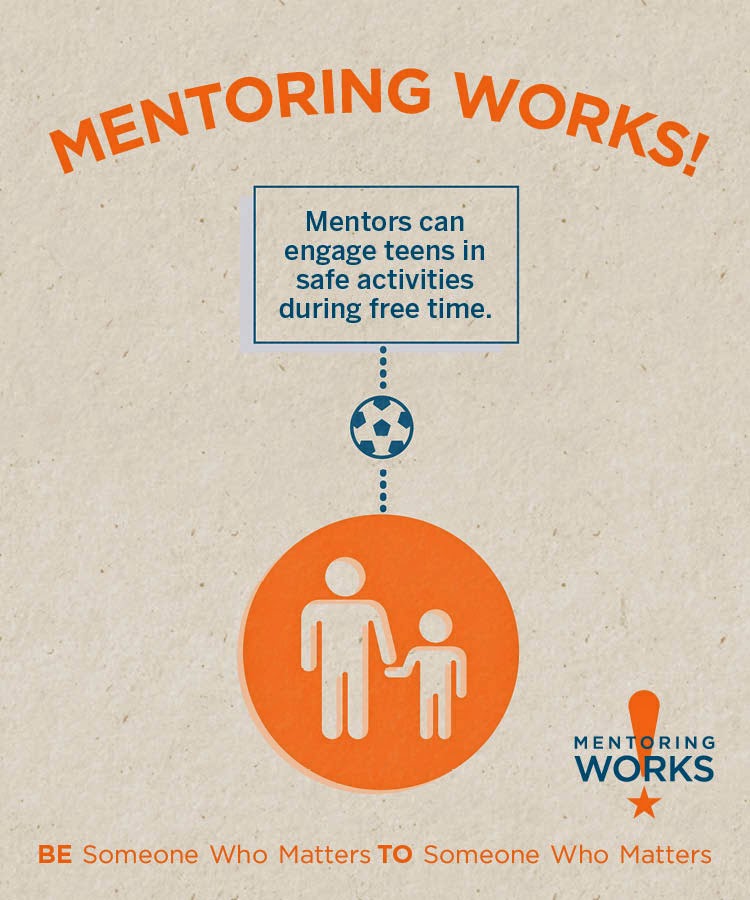
Why Mentoring Works


from the 2014 National Mentoring Month Campaign sponsored by

MENTOR National Mentoring Partnership
Corporation for National and Community Service
Harvard School of Public Health
Office of Juvenile Justice and Delinquency Prevention (OJJDP)
United Way

Wednesday, April 16, 2014

SkillsUSA Forensics and Security Chapter, Mentoring et al.

BixbyBulletin.com


Why Tulsa Tech-Peoria's Skills USA?

At the Mayor’s Mentoring Breakfast at the end of February, Richard Stewart, an instructor in criminal justice as well as a SkillsUSA advisor at Tulsa Tech, talked about his students’ community service and mentorship. Excitement prompted a visit a week later. Stewart’s students exhibited poise, confidence and pleasance. Called upon randomly, they spoke articulately and passionately. What they are learning and doing inspires.

Hands-On Approach
This peer and group mentoring model works effectively through research and hands-on activities to prepare criminal justice students for the workplace and citizenship. By building relationships, the Career Tech students show how to break crime in northeast Tulsa. They are mentors but also mentees.

Mentoring Background
For three years through Tulsa Regional Chamber’s Partners in Education program, members of Stewart’s Skills USA Forensics and Security Chapter have partnered with Tulsa’s Hawthorne Elementary School. In March 2014, his group adopted McClain Eighth Grade Center.

Community Service Wish
According to Stewart, the Tulsa Chief of Police, Chuck Jordan, said that the academy would teach recruits how to handcuff, process a crime scene, and such, but he “would like to see young people come out with a heart to serve and some integrity.” Stewart has incorporated Jordan’s wish as curriculum.

Richard Stewart & the "SkillsUSA Awards Wall"
Community Service Action

The chapter delivers community service in a number of ways. For instance, box top collecting, developing an Angel Tree event, and creating an Easter egg hunt directly benefit Hawthorne. The chapter collected 350 pounds of nonperishable food for Tulsa's John 3:16 Mission last year. For Tulsa’s 2013 BOOHAHA Parade, the criminal justice team built a float, from which members threw 400 pounds of candy they provided. Another service component is education.

Learn First, Teach Others                                        
Students demonstrate to their mentees and others handcuffing, finger printing, lifting latent fingerprints, writing a report, collecting evidence, and photographing and sketching a crime scene.  To promote Drug Awareness Month, chapter members learn PowerPoint to create their own Drug Abuse Resistance Education (D.A.R.E.) presentations.  A Prezi, a cloud-based presentation, illustrates for older students the dangers of methamphetamine. 
Sticker created for D.A.R.E. 

Health fairs and demonstrations can also involve cardiopulmonary resuscitation (CPR) and first aid. Monkey brains add realism and drama. Chapter members have even researched and taught diversity to dispatchers. Opportunities to learn and teach are endless and imaginative.

Encouraging Future Careers
For northeast Tulsa, this SkillsUSA unit hosts a Career Tech fair. This event showcases different careers available in area tech centers during high school and after graduation.


Twelve-Month Calendar
Since the beginning, the criminal justice group has a twelve-month calendar. After formation, for example, the students began feeding the homeless in July.

Networking with Professionals
Creative hands-on learning and benefiting the public often allow students to “hang out” with or assist active personnel from law enforcement, emergency Medical Services Authority (EMSA), fire, and other civil agencies. These professionals also mentor the Career Tech mentors. The Tulsa County Sheriff’s Office and the Bixby Police Department are principal partners.

"Real" Projects
Detailed research and often certification precede some projects such as vehicle inspections, occupational health and safety inspections, presentations about alcohol compliance, and providing event security.  Workplace inspections include a local salon, the Tulsa County Courthouse, and the Dick Conner Correctional Center in Hominy.

A Shop with a Cop partner, the Forensics and Security Chapter members meet the officers and wrap the packages behind the scenes. Working with the Alcoholic Beverage Laws Enforcement (ABEL) officers, these students have been the sting actors. Chapter members hosted the Bixby Citizens Police Academy at Tulsa Tech-Peoria. The experience of the chapter’s spending time with law enforcement and then bonding in the Polar Plunge for Special Olympics can simply not be measured.

Applause!
These highly motivated and overachieving ambassadors of excellence represent Tulsa, Career Tech, and their instructor admirably. With intention, Richard Stewart uses his knowledge, heart, imagination and network to shape the community beyond his class and chapter. SkillsUSA Forensics and Security Chapter, Tulsa Tech-Peoria, is a model of dual mentoring, community service, and education.


Update 
On April 13, 2014, Richard Stewart resigned his commission as a Bixby Police Officer because he won election for the Bixby City Council position. He has applied to the Tulsa County Sheriff’s Office, for which he has worked previously.  


Resources
Photo credit from the BixbyBulletin.com, South County Leader

Ret. 2-28-14

Monday, April 14, 2014

Local Mentoring Programs, OSDE Press Release

Local Mentoring Programs Benefit Students

Efforts Highlighted During National Volunteer Week


OKLAHOMA CITY (April 10, 2014) – This week marks National Volunteer Week, which honors the countless people across the nation who offer their time, skill and compassion to help others in need.
When it comes to volunteering to help children, one of the most effective ways to make a big impression is to mentor.
“A mentorship program can have a strong and immediate impact for a school. Especially for a struggling student, a mentor can truly be a positive role model and friend. It’s such a rewarding way to give back,” said state Superintendent of Public Instruction Janet Barresi.
Mentoring programs come in many varieties. One school that benefits from mentors is Stanley Hupfeld Academy at Western Village in Oklahoma City.
For an hour each week, Stanley Hupfeld visits the elementary school that bears his name to hang out with a boy he mentors. Next year, Hupfeld wants to start teaching him chess, but, for now, they play checkers and talk about geography.
“I’ve often said it’s the best hour I spend all week,” said Hupfeld, former president and CEO of INTEGRIS Health.
Mentors started coming to the school more than a decade ago, back when it was still called Western Village Elementary. Today, it has more than 300 mentors. They are community members with all kinds of backgrounds. Some are older students, and about a third work for INTEGRIS. 
“Our goal is to have a mentor for every student in Stanley Hupfeld Academy,” said Academy director Tobi Campbell. 
Oklahoma has more than 100 mentoring and leadership programs, according to the Oklahoma Foundation for Excellence. The OFE helps establish mentoring programs in schools statewide through its David and Molly Boren Mentoring Initiative.
Mentors provide a stable source of support for students who might not get that at home. They can tutor kids who need academic help, or they can lend a sympathetic ear. By simply visiting with a child for an hour a week, mentors leave a lasting and positive impression.
Bernard Jones, who works with prosthetics at the Oklahoma City VA Medical Center, is in his eighth year as a mentor at Stanley Hupfeld Academy. He admits he was skeptical when he first heard about the program, afraid it would amount to babysitting. 
It didn’t take long to change his mind.
“It’s something I look forward to every week. The kids look forward to seeing me every week,” Jones said.
The program at Stanley Hupfeld Academy is one branch of the Positive Directions mentoring program, which INTEGRIS operates in communities with its hospitals. Each mentor is matched to a single student whom he or she hopefully will stick with until that student graduates to the next school.
What to do with the weekly hour is up to mentors and mentees. Jones said the first 30 minutes of his sessions typically are devoted to study time, but he leaves at least 15 minutes to play games or talk. 
“As they get to know you, they get a little looser and start to share their life stories with you,” he said.
Mentoring programs in Oklahoma have been started at all levels of schools by a range of organizations, including colleges, churches, nonprofits and businesses. 
In Tulsa's Kendall-Whittier Elementary School, roughly 70 students stay until 6 p.m. every weekday to spend time with their mentors. The youth mentoring program was launched off-site by a neighborhood nonprofit in 2003. Several years ago, it became part of the University of Tulsa's True Blue Neighbors initiative and was moved into the school building with help from the George Kaiser Family Foundation.
"We've really seen tremendous growth in our ability to serve students and parents in this neighborhood," said director Danielle Hovenga.
Although the program is free, participants must apply to join. Every kid gets a healthy after-school snack, takes a break for playtime and spends an hour working on academics with a mentor. Half of that hour is spent on literacy, Hovenga said.
Mentors come from across the community and many are associated with the university, she said. Some faculty and staff volunteer, and students can use it as a work-study job or for academic credit in some classes. 
Being able to operate the mentoring program from inside the building has led to better coordination with teachers, and the school staff gets to see the mentoring program in action, Hovenga said.
Beverly Woodrome, director of the mentoring initiative at OFE, said there are too many kinds of successful mentoring initiatives around the state to suggest one model is better than others. In one town, a mentoring program was begun by a local banker who simply recognized a need. In bigger cities, large corporations sometimes hire staff solely to run their mentoring programs. 
There is one basic ingredient both Woodrome and Hupfeld cited; both the school and the mentoring organization need to be dedicated to the program and provide designated leaders on both ends.
Mentors range from top-level executives to school custodians. The more careers and backgrounds represented, the better, Woodrome said.
“I think sometimes we overlook people who could be inspirational,” she said.

FOR IMMEDIATE RELEASE -
FOR MORE INFORMATION:
Phil Bacharach
Director of Communications

Oklahoma State Department of Education

Tricia Pemberton
Assistant Director of Communications

Oklahoma State Department of Education


Saturday, April 12, 2014

Researching Jobs & Careers, Bureau of Labor Statistics

To make a living, one must have an occupation and training/education that will potentially support a family. 

Updating skills and changing jobs--even careers--are parts of reality and the future.  

Research before choosing, and take career aptitude tests.

The Bureau of Labor Statistics's Occupational Outlook Handbook is priceless. Note viewers can click on an occupation to see the profile.  http://www.bls.gov/ooh/

Actually, the entire BLS site is useful. http://www.bls.gov/  Explore! Talk with your mentee.


Part of document, January 8, 2014


Part of document, published January 8, 2014


Part of document, published January 7, 2014


Ret. 4-4-14 for a presentation at the Oklahoma Department of Student Assistance's TRiO Strong Conference, April 10, 2014, in Oklahoma City.


Career - Construction Trades

The last in our Youth Career Day series...

iman-c.com
Speakers
  • Jimmy Fish, Executive Director, Oklahoma Building & Construction Trades Council   
  • William Bryles, President, AFSCME Local 2406, AFL-CIO  City, County & Municipal Workers of Oklahoma

Two routes to construction trades
(during or after graduation)
  • Career Technology Center
  • Apprenticeship Program

About fourteen different crafts are involved in the construction industry, e.g., electrician, carpenter, plumber, pipe fitter, bricklayer, insulator, iron worker, operating engineer, painter/decorator, sheet metal worker, and others.

Training is monitored and certified by the U.S. Department of Labor.

barbarajohnsonphotojournalist.com
In 1971, motivated by his friends' making more money than he would have if he had finished college, Fish began looking at the trades industry. 

Apprenticeship
An apprentice learn a trade while working in a three- to five-year program and pays no cost for this training. He or she can also attend school.

Journeyman
Becoming a journeyman, an endorsement with a higher level of skill, accomplishment and income, has requirements and certificates [testing] beyond completing apprenticeship training.

Advice
  • Prepare yourself in math and science. Algebra, for example, is important in electrical training. 
  • Be a high school graduate.
  • Don't waste your high school years.
  • Get your G.E.D., even if you are an adult.
  • Prove you can 
            -  Be punctual 
            -  Be responsible
            -  Handle class

Competition for Jobs
Limitations exist on the number of positions available, perhaps 50 to 15. What do you need to be employed? Three things
  • Interview
  • Grades
  • Practical experience

Resources

* At technology centers, students can earn college credit.

newcastlewelding.com.au
Did you know? 
Six cranes helped build the Devon Tower, and each crane had a highly trained operator. At peak, 1,500 people worked on that building. (Bryles)


Focus
A minority of high school students know where they want to go and in what to focus. Those who have not determined a direction can attend career tech or a two-year college until deciding. While pursuing training or education, a minimum wage job allows a degree of independence while building experience and connections.

Illustration
An adult went to a career tech center for welding at a cost of about $1,000. Although he earned a position as one of the two top welders of his class, his having taken welding at career tech while in high school and/or appropriate preparatory classes in high school would have saved time and money.