Friday, April 11, 2014

Career - Graphic Designer & Fine Artist, Darryl Hillard

Another speaker at Youth Career Day...


Darryl Hillard attended Northeast Academy and graduated from Midwest City High School. Incidentally, in high school, he played varsity football and participated in art club and Distributive Education Clubs of America (DECA), which fosters leadership and entrepreneurism for careers.

Overcoming Adversity
Hillard’s mother died during finals of his first year of college at Oklahoma State University. He had two younger brothers at home so he chose to be an example for them.

Plan
About college, he says to be proactive, i.e., to schedule and plan. Oklahoma’s Promise scholarship, Oklahoma Higher Learning Access Program (OHLAP), had a five-year limit. He had a good GPA in high school, but his ACT was not so good. College required effort.

Dealing with a Setback
His performance in the first three courses of his major showed he was not good enough to be a graphic designer. He changed into the studio art program, where a few years later, he became the best artist. Becoming a showcase artist boosted him so he focused upon becoming a professional artist.

In his senior year, a new graphic design professor on his own time gave Hillard private lessons. Even with his regular courses, work, and private lessons, Hillard graduated.

“It’s all about mindset,” he said.

Employment
Once he graduated, he looked where the money was and applied for work. He built a website to display his art.

His first job was in Yukon, which he still loves. He is now a full-fledged, full-service graphic designer, i.e., doing all that can be done with art, conventionally or digitally. Hillard also continues his passion for fine art.

Highly motivated, he has his own business, DH Art & Design, and serves as the marketing coordinator/graphic artist at Knutson Irrigation Design.

Salary
In Oklahoma City, a graphic designer may earn from 35,000-60,000 a year.

Advice
  • Love what you do.
  • Be proactive.
  • Don’t let anyone tell you that you cannot do it.
  • Be persistent. Never give up.


About Hillard and Designs/Art
https://www.facebook.com/dhartdesign86                                                    http://www.darrylhillard.com/about.html                                                        http://www.linkedin.com/in/djhillard       Ret. 4-11-14


[Having seen his work and having heard him speak, we hired Darryl Hillard to design our Magical Mentoring Tour graphic materials for OFE's Boren Mentoring Initiative.]

Sunday, April 6, 2014

Career - the U.S. Military Forces

blirk.net
The military can become a career or a step toward a career.

Pros
Through enlistment in the Navy, Marines, Air Force, Army, or Coast Guard, recruits will be trained in a number of career areas. The military pays for school. Life in the military can offer opportunities for world travel. 

Veterans have the G.I. Bill to pay for college tuition. Sometimes veterans have priority over civilians for certain jobs. Almost all employers value military discipline and training in an employee. 

Serving in the Reserves after resuming civilian life has benefits, too. For others, serving honorably in the military has been become a step to political life. 

Cons
Although the branches of the military have many positive opportunities and outcomes, military rules are not for everyone, and virtually everything has a military rule, e.g., how a soldier wears his or her hair, socks, uniform, and so on. Discipline is strict, and punishment can be more rigorous than in the outside world. Personal freedom is restricted, too. Long deployment separates families.  In a war zone, of course, death, dismemberment, and other impairment are real.

In his 2010 article below, Kingsbury says:
In fact, the modern military has a "tooth-to-tail" ratio of 1-to-10 or more. Those are the estimated numbers of frontline troops compared to logistics and other support personnel. 


coastguard.dodlive.mil
Officer
A person with a college degree, if otherwise qualified and fit, enters the military as an officer.

Enlisting
Enlistees must be eighteen years of age. Recruiters do look at the high school record of potential enlistees if that is the last or only academic record, e.g., an adult without postsecondary education or training. [What you do or don’t do in high school matters!]

Testing
Critical for placement, the ASVAB, a career exploration/aptitude test, is the key. [As mentioned in previous posts, take the practice tests.]

ASVAB or the Armed Services Vocational Aptitude Battery, is a multiple-choice exam given by the United States Military Entrance Processing Command. It was first introduced in 1968 and is now the most widely-used standardized aptitude test in the world.
The test must be completed if you wish to serve in the Army, Navy, Marines, Air Force, or Coast Guard. The test can also be taken as a career-exploration tool if you are a high school sophomore, junior, or senior. It takes approximately three hours to complete. If you take the computerized version of the test, results are given immediately. If you complete a paper and pencil test, you'll get results within two weeks.
commons.wikimedia.org
There are nine individual tests on the exam:
  • Electronics Information
  • Auto and Shop Information
  • Mechanical Comprehension
  • General Science
  • Arithmetic Reasoning
  • Word Knowledge
  • Paragraph Comprehension
  • Mathematics Knowledge
  • Assembling Objects (This section is only on the computer version and is not part of the paper and pencil test taken by high school students.)
http://www.asvabpractice.com/    Ret. 4-4-14              
outontheporch.org


ASVAB as Job Qualifier

Anecdotally, for the Navy, the highest ASVAB score will qualify a candidate for the nuclear program, which is second only to the Navy SEAL program. For example, a machinist mate on a submarine must have a higher ASVAB score in certain combined subtests than a machinist in any other part of the Navy.

Monthly Pay 2014


Always research career opportunities, job shadow if possible, and talk with people in the targeted professions. 

Saturday, April 5, 2014

Career - Truck Driver, Shawn Greshon

At STAAR Foundation's Career Youth Day, a highly replicable model, Shawn Greshon, a professional truck driver, shared his occupation and the opportunities therein, e.g., as a “transitional” job while continuing postsecondary education.

Greshon, who has driven two years for Pepsi, earned $48,000 last year. He does have a Commercial Driver’s License (CDL). Since truck driving jobs “don’t require more than a high school education,” truck driving gives students “the opportunity to make a fair wage while going to school. Some trucking companies even offer college tuition assistance,” Greshon stated.  

Truck driving does involve a clean driving record, a written test, a driving test, a minimum age, certain physical qualifications, and often random drug testing. [Keeping your record clean matters regardless of career!]

U.S. Department of Transportation
Car haulers, the drivers of semi trucks hauling cars, can earn $100,000 a year here, but they must have more licenses, endorsements and training for many companies.

Commercial Motor Vehicle (CMV) driver training, which endorses higher knowledge of regulations and more responsibilities of drivers, may cost $5,000 at the driver’s expense. Coca Cola and Pepsi , for example, can train drivers for the CMV.

“Further education is necessary for those who haul fuel or hazardous wastes,” Greshon commented.

“Testing a driver’s knowledge base is key to safety,” he added.

Explore online to learn more. Talk to commercial truck drivers. So many different areas of driving exist, e.g., long haul or short haul; flatbed, tanker, refrigerated, auto and others; sizes by weight, and so on.

Trucking can also be a career, in which a driver rises to higher levels. It can also be the basis of a trucking company, e.g., Sapulpa’s John Christner Trucking (JCT), begun with only two trucks and the founder’s twenty years’ experience as an over the road driver. Starting, maintaining, and growing a business, however, requires much work and worry.  http://www.johnchristner.com/?r=about&abt=companyhistory

[General information below. Oklahoma may have other steps.]

How to Get a Truck License 

If you want to become a professional truck driver, you should get a Commercial Driver's License (CDL). The main requirement to get this type of license is to take written exams including general knowledge test, an air brakes test, and the combination vehicle test.

Many people like to take the optional endorsement tests for hazardous materials, tankers, and double and triple trailers, in the event of transporting dangerous products. If you are still a student, you have to travel with a CDL-licensed driver since permits only last six months. 

1.eere.energy.gov
The next step after having the permit is to learn how to drive a truck. There are specialized schools that may teach you how to maneuver the truck because you have to demonstrate in the tests that you are able to park, back, inspect the vehicle before driving it, and conduct an air brake test.

In order to pass all these tests, you should acquire a lot of information so that your knowledge goes beyond what is required.

The best recommendation is to attend classes in a school that offers a complete combination of interactive activities such as computer-based training, prepared instructors, and practices on CDL tests.

Remember that you are paying for receiving good preparation, so do not hesitate to ask as many questions as you can.


Friday, April 4, 2014

Career - Chef, Emily Walsh

At the STAAR Foundation's Career Youth Day, a highly replicable model, Emily Walsh, a professional chef and instructor, discussed her profession.


Chef Emily Walsh, the Culinary Institute of Platt College, Oklahoma City, has two specialties, culinary arts and pastry. Walsh runs the café/restaurant, Chefs Di Domani, and also trains pastry students. In both areas, mastery must include efficiency and large quantities.

Chef Walsh says the culinary industry always has jobs. People eat. The opportunities are diverse, e.g., cruise ships (24-7 food), hotels, casinos, restaurants, hospitals, clubs, catering companies, correctional institutions, education institutions, and others. “If you can work on a cruise ship or at a hotel, you can work anywhere,” she adds.  

"Salaries depend upon where you start and the job, e.g., $25,000 and up, varying from a mom and pop café to a casino or hotel," she added. [$57,591 average salary; in Oklahoma City, $50,340. http://salary.careerbuilder.com/Executive Chef] 


As a chef, “you are in charge, making food, taking orders, and doing other tasks,” she explained.

Each program differs. The pastry program is ten months long whereas the culinary arts one is a year and a half.  Students can take classes during the day or at night while working. Platt College helps place students after graduation. Services include internships and resumes.

Jim Anderson food lab at OSU's College of Human Sciences

The differences between a chef and an executive chef include taking a test. 

Chefs have a hierarchy based upon accomplishment and 
expertise. A sous chef, for example, controls the kitchen and lines.

 An executive chef is the top chef or manager. Doing little or no cooking at that level, he or she may standardize the recipes, plan menus fitting a budget, manage a team of kitchen workers, train staff, maintain quality, and so on. Chefs work up to the executive chef position.

[“Aside from having exemplary culinary skills, executive chefs must have good communication skills, time management skills, leadership skills and basic accounting skills in order to run a kitchen successfully.” http://careerbear.com/]  

One recurring point made during the career youth day presentations was that students of all ages can work full- or part-time while learning. 

Platt College                                                                             

OSU’s School of Hotel and Restaurant Administration, et al.     http://humansciences.okstate.edu/about-us# 

Culinary Schools in Oklahoma                                                                     http://www.educationnews.org/career-index/culinary-schools-in-oklahoma/

Search online for other culinary or related schools or programs in other states.

Online quotes ret. 4-1-14

Thursday, April 3, 2014

Career - Medical Doctor

In continuing the discussion of this effective youth career day model with content provided by professionals, today's post focuses upon one Oklahoma doctor, a minority student and graduate of the University of Oklahoma. She is board certified in emergency medicine. 

She decided to become a doctor in second grade. Initially, she was inspired because one of her friends’ parents, a doctor, owned a luxury. As a young adult, however, she realized that helping people was her real motivation. 
jantoo.com

Career exploration, networking, and resume-building began early. In sixth grade, she volunteered as a Candy Stripper. In ninth grade, she was in summer programs and looking for internships "to let me see if I liked the career and to make connections.”

A medical doctor mentored her. When she received her letter of acceptance to medical school, she said she was “screaming.” She received a second letter announcing she had a free ride, and she had not even applied for one.

She added that hard work and connections were the keys. She also did job shadowing.

The rewards originally were about money, but now she sees how hard it is to be an emergency doctor, who must work with a team and make critical decisions. For example, determining whether symptoms are heart burn or a heart attack is an enormous responsibility based upon knowledge and reasoning.  For her, emergency healthcare is not about money. “Every day is different and interesting,” she told the audience. 

As a child, she was always reading a book. Her reading helped her process information fast. That fast-processing skill helped her with testing.

Participating on selection committees, this doctor sees things that shut doors, e.g., grammar and outward appearance. The committee sees you before they hear you.

Pointers
  •  A four-year college has certain prerequisites. Learn them and take the required courses.               

  • The Medical College Admissions Test (MCAT): No one can get into medical school without a good MCAT score—no matter how smart you are. Later doctors take a medical licensing examination. Every ten years, doctors take a board certification test. 

  • Welders, teachers, doctors, nurses, and others must take tests. Always take course reviews. The MCAT review course costs $1,000 but was worth it. Review courses can be found at Princeton Review, Kaplan and others. Always go in with the same preparation as those ahead of you.

  • In four years of medical school, fifteen hours a day is spent studying. Half of a medical student’s time is spent living in books and half in clinical years, in which rotations follow different specialties. [For example, medicine, 12 weeks; neurology clerkship, 4 weeks; obstetrics & gynecology clerkship, 6 weeks; primary care clerkship, 4 weeks; psychiatry, 4 weeks; surgery clerkship, 12 weeks...                                   http://doctorpremed.com/clinical-rotations.html]

After an interview, a medical student is invited to complete a residency in a hospital. Depending upon the specialty, residency may be from three to seven to ten years. Usually, the longer the training, the more money a doctor makes, but that is not always the case. Her residency was in Chicago, where people waited an average of twelve hours to see an emergency room doctor. 

She started as a grocery store bagger and then rose to cashier. She emphasized, "To be a good leader, you must be a good servant."

Supply and Demand
Emergency care is really expensive compared to scheduled care so it is limited. The Affordable Healthcare Act introduces 27 million patients into the healthcare system. Physicians' assistants, registered nurses, nurse practitioners, and other health-related occupations of all levels will increase. 

 More Advice

“It’s not what you know but whom you know.”

“Find something so interesting you would do it for free.”

“Education is freedom.”

“Do well in school.”

“At your stage, read! Don’t worry about anatomy.

“Practice to be good.”  [not just for tests]

“In ninth, tenth, and eleventh grades, practice for standardized tests. These tests are the tickets to get into a good school.”

“Online, practice standardized tests. If you do well, doors open. If you do badly, doors close.”  

"Educate yourself to find resources available."

Updated 3-20-15

Wednesday, April 2, 2014

Career - Computer Engineer, Wayne Jones, Ph.D.

Brandon Douglas and
Dr. Wayne Jones

In continuing the discussion of this effective youth career day model with content provided by professionals, today's post focuses upon Dr. Wayne Jones.

Wayne Jones, Ph.D., who worked on the cruise missile and became chief engineer of the B-I Bomber, also earned positions as Vice President, Tinker Air Force Base, and Chief Systems Engineer, Oklahoma City Logistics Center. 

Now Dr. Jones is now the dean of English and science at Rose State College in Midwest City. In 2010, Jones retired after thirty years at Tinker Air Force Base, where he had earned becoming director of engineering. Then he went to Rose State. As he commented, “I had too much energy to sit on the porch. I wanted to do something in education.”

He encouraged students to do something in STEM because that is where jobs are now and will continue to grow. As he said, “The future is in STEM.”

His journey has been nothing short of amazing. As he said, from 1974 until now he has been blessed, never having been without a job, not even one day, because of his career choice. (We add also because of his work ethic, work quality and personality.)


Beginning humbly, he reached his goals. Growing up in Spencer, he attended Dunjee High School, where he had good teachers, although the school was generally underrated in academics. Langston University was a great experience for him. The three thousand students from all over the country intimidated him at first. A rural “kid,” he wasn’t sure he could compete. After a semester or two, he knew he could.

His success was all about persistence. Some students were smarter. Some students did not go to class. He realized with more persistence he could stay the course.


He worked in Boeing Computer Services in Phoenix. At this time, Boeing, Honeywell and Motorola had the super computers. About seven years later, he went back Arizona State for his master’s degree in computer engineering. In 1977-78, this was a very big college with 52,000 students. A little intimidated, he went to class, did his homework, persisted, and earned the degree.  

While at Tinker and motivated by a love of lifelong learning and staying current in his field, he took an engineering course at the University of Oklahoma. He had a job, liked the course, which was fun but no pressure, so he continued to take evening classes. Soon he had four or five courses. Eventually, he earned his Ph.D. in engineering from the University of Oklahoma.

As part of his experience with Tinker, his most rewarding job was in Saudi Arabia, but he also worked in Europe. His major and later his occupation allowed him to have unique opportunities after high school.

During his presentation, Dr. Jones held up a device and asked, “What is it?” Some answered a cell phone, some a camera, others mentioned different functions of the device. A cell phone is a hand-held mini-computer constantly being re-engineered. He asked the audience, “How would you like to design the next generation of this device?”

An audience member asked about weak math skills in middle or high school. Common sense suggests requesting formal or informal help now and as needed in the future. Dr. Jones said that Rose State College, a two-year institution, like other universities and colleges has tutoring help available and also remedial classes if needed to sharpen skills. 

Advice: “Be persistent.”

Disclaimer: This post will inadequately convey the details and impact of the actual presenter.  

Tuesday, April 1, 2014

Youth Career Day Model

This model included a group of youths who needed to learn about more options than they currently knew or experienced; to believe that they, too, could achieve; and to learn that many paths, direct and indirect, lead to success.

The original design was to have three sessions with two speakers assigned to each of five rooms. Attendees could eat, socialize, attend sessions related to their top career interests, ask questions, attend another session if they wished, move on to the typical “college night” or career recruiting tables, and then network before leaving. The vendors represented area colleges and a career technology center.

Event Poster by Darryl Hillard


ONE LARGE ROOM
Everyone, however, met in one large room set up with round tables. Professionals, speaking from the podium at the front, spoke to all attendees. Each presentation was about fifteen minutes followed by Q & A. Refreshment tables in the back of the room and vendors’ tables on the right were convenient. The one big room's utility and intimacy perfected venue.

CONTENT provided by "real" people
Each speaker talked about his or her own journey, often incredibly difficult or seemingly impossible, and offered tips for success. The content variety increased the value beyond typical career/college information events. 

Professionals repeated how education or training, even continuing over time, would improve earning ability and self-esteem. In addition, they spoke about soft skills, levels of employment, salaries, and various paths for students without scholarships or funding, i.e., working full or part-time while earning an education.

Examples of career presenters included a dentist, registered nurse, engineer, graphic designer, dean, doctor, chef, truck driver, welder, construction association representative, apprenticeship training resource, a union president, sailor, etc. 

Recurring Themes
  • Continuing postsecondary training/education
  • Tying the present to the near and distant future, e.g., the journey
  • Goal-setting, goal-achieving and perseverance
  • Academics, leadership, team-playing and behavior
  • Test-taking continues in most professions, e.g., licenses
Sivilay Manisy, Metro Tech Marketing/Communications

Audience
  • Middle school students
  • High school students
  • High school graduates
  • Dropouts
  • Parents

AGENDA
Serendipitous Plan - shorter than scheduled 

Original Plan 10:00 am -2:00 pm
Registration: 10:00 a.m. to 10:30 a.m.         
Welcome: 10:30 a.m. to 10:50 a.m.            
Session I: 11:00 a.m. to 11:45 a.m.           
Sessions II & III            
Closing Remarks: 15 minutes  


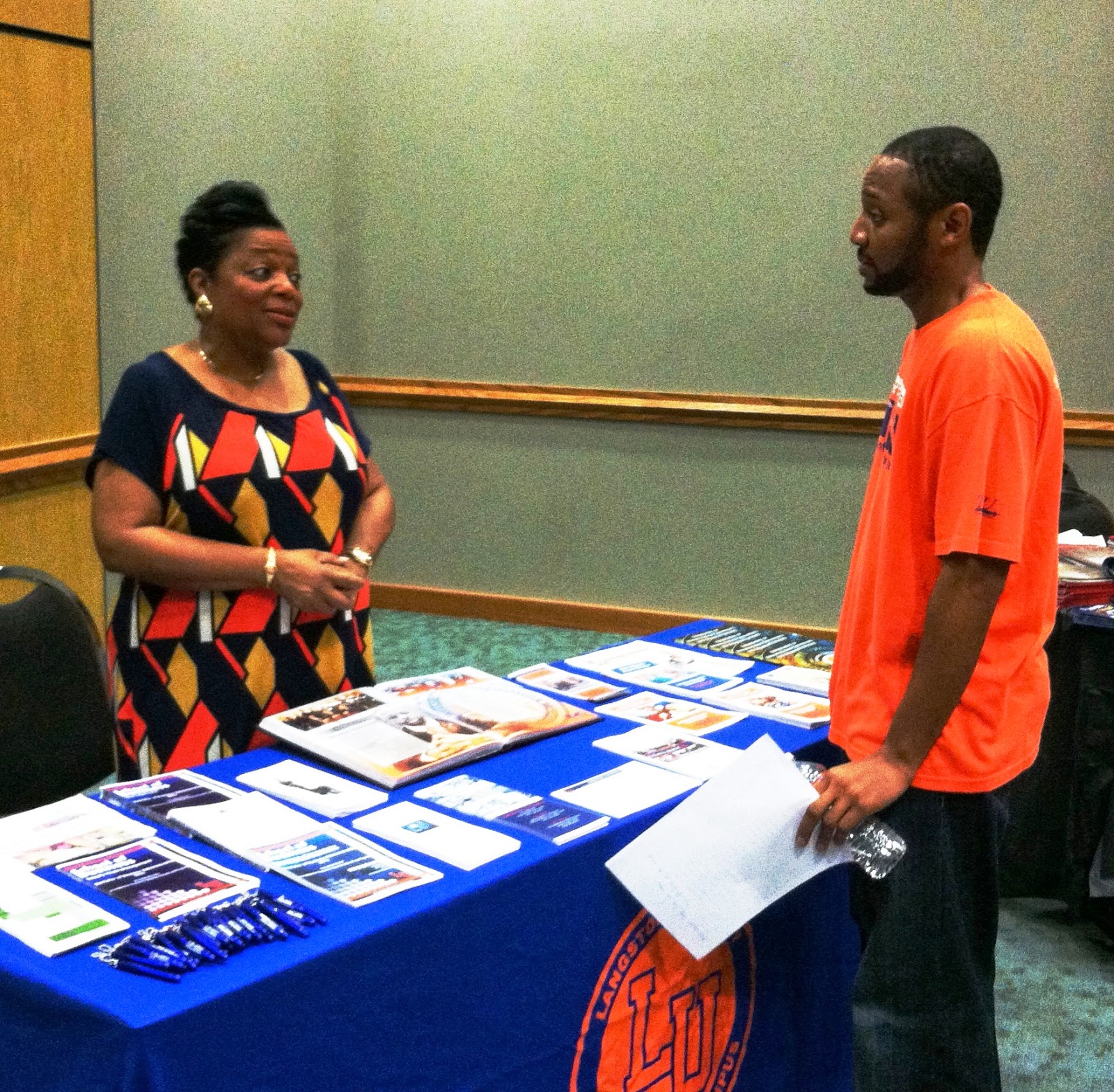
Discussing Langston University
OTHER
Event Registration: www.eventbrite.com

Advertising Facebook, website, email, posters, and word-of-mouth

Possible Event Sponsors/Organizers A school, community, career technology center, church, business, or other entity or entities in partnership could organize such an activity. Refreshments and door prizes were donated.


Actual Sponsor and Organizer of the All STAAR Youth Career Day 2013

Cathy Poteet, Marketing/Communications


STAAR Foundation, founded and directed by Gerald Scott, sponsored this career day. The leaders of its S.I.S.T.E.R.S. Mentoring Program created the vision and plan, executed by staff and volunteers from STAAR and its Tradesman Mentoring Program. 

Katawna Stephens was the event coordinator along with Contessa Duncan, Tyechia Crowder, Brittany Johnson, and Lynette Jones, other S.I.S.T.E.R.S. leaders. 

UCO Materials