In Chicago, BaconFest is a huge hit with $50,000 of the proceeds going into the local food bank. Local restaurants display their best and most creative bacon recipes including bacon desserts.
Sunday, August 10, 2014
Fundraising - BaconFest 2013, Chicago
As we mention periodically, every small town in Oklahoma probably has or should have its own local festival to bring money into the local economy.
In Chicago, BaconFest is a huge hit with $50,000 of the proceeds going into the local food bank. Local restaurants display their best and most creative bacon recipes including bacon desserts.
Saturday, August 9, 2014
LGBTQ Youth Resources
Mentoring groups as well as schools and religious institutions have young people who are lesbian, gay, bi-sexual, transgender or questioning. The Center for Disease Control has some often dire statistics on these youths, who are bullied in multiple ways.
Regardless of differences, these are still highly at-risk children, teenagers or young adults who need nonjudgmental mentoring (and/or parental) relationships.
Below are two sites. The National Resource Center for Youth Development (NRCYD) has resources for "Youth in Care," but those of us not mentoring youth in care can still learn from the information. The second source is from the Center for Disease Control.
http://www.nrcyd.ou.edu/lgbtq-youth
Regardless of differences, these are still highly at-risk children, teenagers or young adults who need nonjudgmental mentoring (and/or parental) relationships.
Below are two sites. The National Resource Center for Youth Development (NRCYD) has resources for "Youth in Care," but those of us not mentoring youth in care can still learn from the information. The second source is from the Center for Disease Control.
http://www.nrcyd.ou.edu/lgbtq-youth
http://www.cdc.gov/lgbthealth/
![]() |
| CDC |
Thanks to Kathy Taylor of Life Launch, a program of Stand in the Gap Ministries, for sharing the NRCYD organization and resources with us. The LGBTQ section is just one important topic on the website.
Life Launch mentors foster alumni in the Tulsa and Oklahoma City areas.
Ret. 8-7-14
Friday, August 8, 2014
Preventing Teen Pregnancy
Mentoring organizations can train with mentors to address prevention of teen pregnancy. As the Oklahoma teen birthrate suggests, just expecting or demanding abstinence does not work. Education is a critical key for male and female mentees.


http://okgazette.com/2014/08/05/prevention-key-to-combating-teen-pregnancy/
Ret. 8-6-14
Prevention key to combating teen pregnancy
By Teddy Burch |

From left highschool students, Micayla Thibodeaux (17) and Chase Gulliver (17),
present a Teen EmPower class to 7the graders at Delcrest Middle school with Exec
Director Kathy Harms. (Shannon Cornman)
The truth
One ounce of prevention is worth a pound of cure, or in this case millions of Oklahoma tax dollars each year. In 2010, the state of Oklahoma spent $169 million on teen childbearing. However, very little money is allocated for expanding education to prevent teen pregnancy.
“Many nonprofits are about reacting,” said Kathy Harms, executive director and founder of Teen EmPower. “They are spending time and resources working with pregnant teens, and I say let’s back up a bit. Let’s try to increase education so the teen doesn’t end up in the situation.”
Ten years ago, Harms began Teen emPower with the focus of preventing adolescents from taking part in high-risk actions through youth education.
“We need to take a prevention approach,” Shanté Fenner, education and training director at Oklahoma Institute for Child Advocacy, said. “We educate on the importance of wearing seat belts. We talk about the reasons why we shouldn’t smoke. Why would we want to prevent teaching accurate information on this topic?”
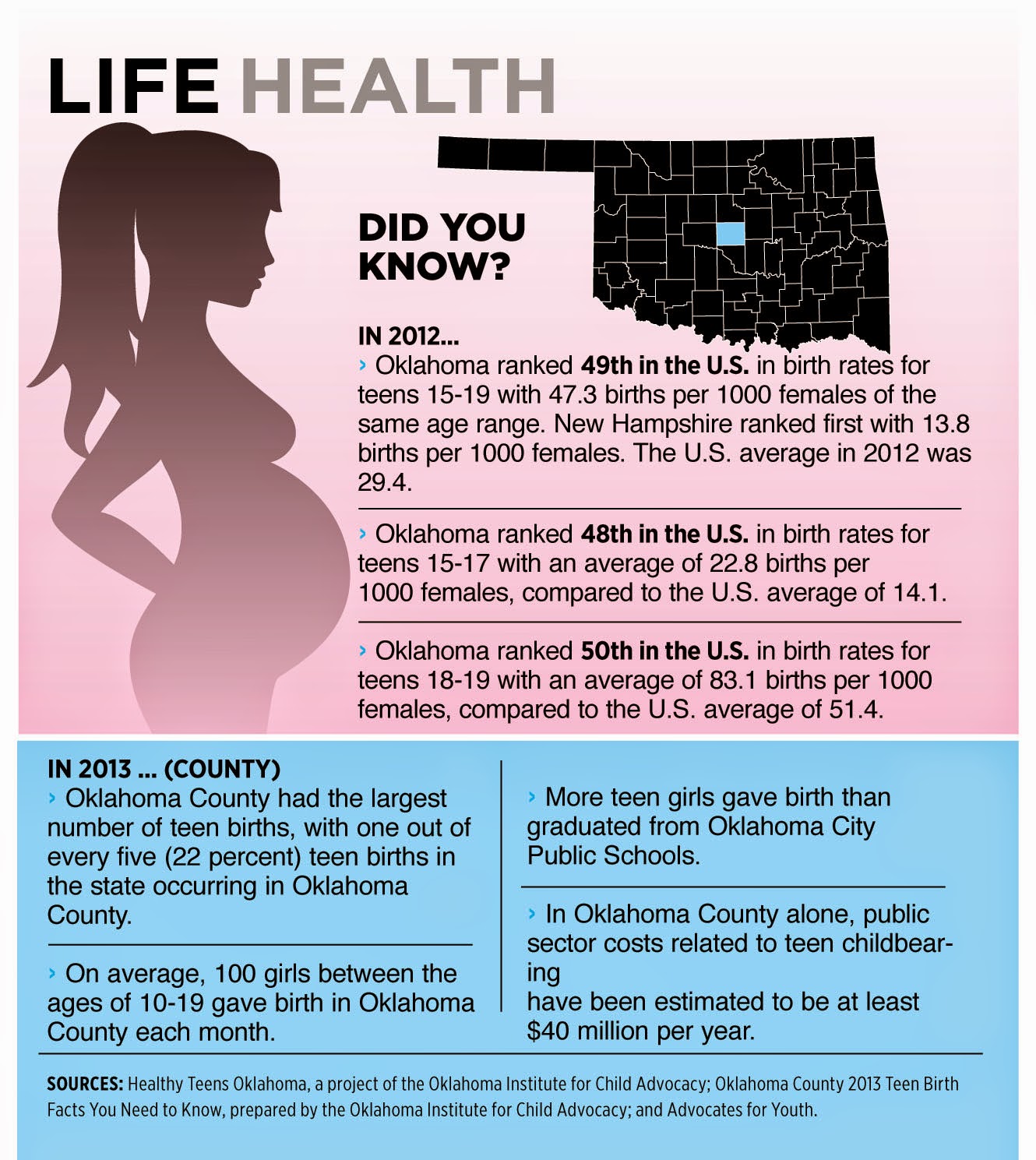
Overall, teen birth rates are going down. Six years ago, Oklahoma had 7,581 births to girls ages 19 and younger; in 2013, the state had 5,379 births to girls ages 19 and younger — a 29 percent decrease.
However, to put that into perspective, more 18-19-year-olds in Oklahoma gave birth in recent years than entered the University of Oklahoma and Oklahoma StateUniversity as freshman.
“The teen birth rate in Oklahomahas ranked too high for way too long,” said Sharon Rodine, youth initiatives director at the Oklahoma Institute for Child Advocacy. “The benefits of preventing youth pregnancy are enormous. Other challengessuch as child neglect, poverty, even unemployment can be affected by this. The good news is that this is preventable.”
Currently, there is not a teen pregnancy rate because there is no way to accurately track pregnancy rates. However, what is monitored is teen birth rates, and in 2012, Oklahoma ranked 49th in the country — just ahead of New Mexico — for the highest teen birth rate of girls ages 15-19 and 50th (the highest and worst) in the country for ages 18-19.
“In our country, we do poor job of discussing sexuality with young people. And as a result, we have the highest rate of teen births of any of the industrialized nations in the world, and for many sexuality transmitted diseases,” Harms said.
Not really reality
Reality television, music and filmpromote or even glorify teen pregnancy; however, the truth is an extremely different picture. For Harms, the hardships of teen pregnancy began at 15 and increased after giving birth at 16.
“For many years, I would have to wonder, ‘Am I going to pay the gas bill or am I going to pay the electric?’ because I knew I wasn’t going to be paying both,” Harms said. “Or I would wonder, ‘Am I going to buy diapers or am I going to pay rent?’”
The majority of teen mothers are single, and the demand to do whatever it takes to make ends meet becomes overwhelming. Many times, this results in not being able to dedicate 100 percent of your time to your child due to the demands of work and overall survival. In many cases, it is the child that suffers.
“Whenever you are going to take a child to daycare, what do you think is the first thing a single parent is going to ask?” Harms asked. “While it should be, ‘Are you going to take care of and protect my child?’ actually, it is ‘How much?’ And the lowest bidder … is the winner.”
It’s about education
Nelson Mandela believed education to be the most powerful weapon available to change the world. Harms and Teen emPower’s mission follows a similar undertaking. Their approach isn’t about pro-life or pro-choice; it’s about pro- prevention and educating teens.
“It is so widely promoted that talking to teens about the subject promotes it; however, this is just not true. [It’s difficult to get] people [to] understand we are not promoting [sex], we are about promoting healthy information,” Harms said. “You are nota bad person for thinking about sex. You are not a bad person if you have had sex. You just need to know what all is involved with it.”
Rodine believes in youth education and that there is a role for everyone in teen pregnancy prevention. This is the thought behind Advocates for Youth’s Let’s Talk Month, which takes place this October. Parents, caring adults, youth- serving organizations and communities can focus on ways individuals can help young people make good decisions and avoiding risk-taking behaviors.
“Let’s Talk Month encourages parents and caring adults to be available and open to young people in talking about healthy relationships and preventing teen pregnancy,” Rodine said. “We don’t want this focused on school sexuality education or clinic programs. We want the focus on parent-child communication, tips for parents, ideas for increasing community awareness and opportunities to talk with and guide youth.”
Understanding the diverse backgrounds of families within the community has been a large part of the success of Let’s Talk Month. The program allows agencies, religious institutions, businesses, media, schools and parent groups to plan events that inspire parent/child communication about sexuality.
“Society has this notion that information [about sex education] is being taught at school or at home,” Fenner said. “It’s being shown that its not. Simply put, parents are the best educators, and we must teach accurate information.”
http://okgazette.com/2014/08/05/prevention-key-to-combating-teen-pregnancy/
Ret. 8-6-14
Wednesday, August 6, 2014
How to Get Good Grades, 10 Steps
Tuesday, August 5, 2014
Workshop for Seniors
Researchers have looked at the National Guard model and then piloted an intervention. We are proud that Oklahoma has a successful National Guard Youth ChallenNGe Program, the Thunderbird Youth Academy, in Pryor.
We can learn from this research found in the Chronicles of Evidenced-based Mentoring, University of Massachusetts at Boston. The pilot intervention described below is highly adaptable for pre-collegiate students anywhere in our state.
By Sarah Schwartz July 8, 2014
Teaching Students to Recruit Academic and Career Mentors: Preliminary Results from a Pilot Intervention
by Sarah Schwartz, Ph.D.
As we have written about before (see post), there is evidence to suggest that Youth Initiated Mentoring, as implemented by the National Guard Youth ChalleNGe Program, may be an effective approach to mentoring vulnerable adolescents.
Under this model, youth nominate adults from their existing social networks to be their mentors, and then programs provide screening, training, and monitoring of the relationship, in essence, turning the relationship into a formal mentoring relationship. We know, however, that natural mentoring relationships can be just as effective as formal mentoring relationships, or even more so.
An ongoing question for me has been whether we might see positive impacts simply by providing youth with the training and support to identify, reach out to, and develop relationship with potential natural mentors in their lives without ever formalizing those relationships.
A pilot intervention that we recently completed at the Center for Evidence-Based Mentoring attempts to do just this. In collaboration with Urban Scholars, a pre-collegiate program for students typically underrepresented in college settings, Stella Kanchewa and I designed a workshop for seniors in high school that aimed to teach them how to identify and connect with potential academic and career mentors.
The workshop included lessons exploring the benefits of mentoring relationships and different types of social support and social capital, creating eco-maps (graphical representations of youth’s existing relationships) to identify potential sources of social support, and practicing how to reach out to and connect with adults (both through role-playing as well “real-world” conversations and interviews with adults in their social networks), including potential rejection.
Since a particular focus of the program was developing academic and career mentoring relationships during the transition to college, we also focused on networking, professionalism, and “codeswitching” when connecting with adults across contexts.
Although youth did not leave the workshop with a formal mentoring relationship, they were asked to identify an adult from their existing social network to support them during their transition to college and to explicitly discuss how and when they could reach out to that person. The workshop culminated in a “Networking Night” in which the students practiced introducing themselves and connecting with professionals from a range of fields.
Initial analysis of interviews with students suggests that such training can increase the value adolescents place on mentoring relationships and social capital, as well as developing their “help-recruiting” skills and their self-efficacy in reaching out to potential academic and career mentors.
In addition, there is preliminary evidence that such an intervention may increase their ability to access social support from nonparental adults. In future studies, we will be collecting follow-up data to explore the longer-term influence of the workshop on students’ relationships during their first year of college.
We are still in the very early stages of exploring this approach, but it may represent an effective strategy to facilitate the development of supportive relationships between young people and adults by allowing youth to mobilize the support of the adults in their lives.
http://chronicle.umbmentoring.org/teaching-students-to-recruit-academic-and-career-mentors-preliminary-results-from-a-pilot-intervention/ Ret. 8-5-1
Note: For the blog, we split the paragraphs to make reading easier.
Saturday, August 2, 2014
Identifying & Encouraging Strengths
![]() |
| TeamMates.org |
The quote by Einstein sums up the need to focus on any individual's strengths--especially those of a young person.
Retired Nebraska Head Football Coach Tom Osborne and his wife Nancy began TeamMates in 1991.
http://teammates.org/strengths/
Friday, August 1, 2014
Mentor Recruiting - Big 12 Conference, et al.
Announcing Oklahoma's first year to participate in the Coaches' Mentoring Challenge 2014, we are ecstatic that OU Head Football Coach Bob Stoops and OSU Head Football Coach Mike Gundy are endorsing this mentor recruiting effort in Oklahoma.
Coaches Gundy and Stoopts want fans, fellow coaches, staff, faculties, students and communities statewide to sign up to be a mentor.
See the Big 12 announcement.
Subscribe to:
Posts (Atom)